
Anti-CD30 CAR-T Cell Therapy in Relapsed and Refractory Hodgkin Lymphoma
Overview
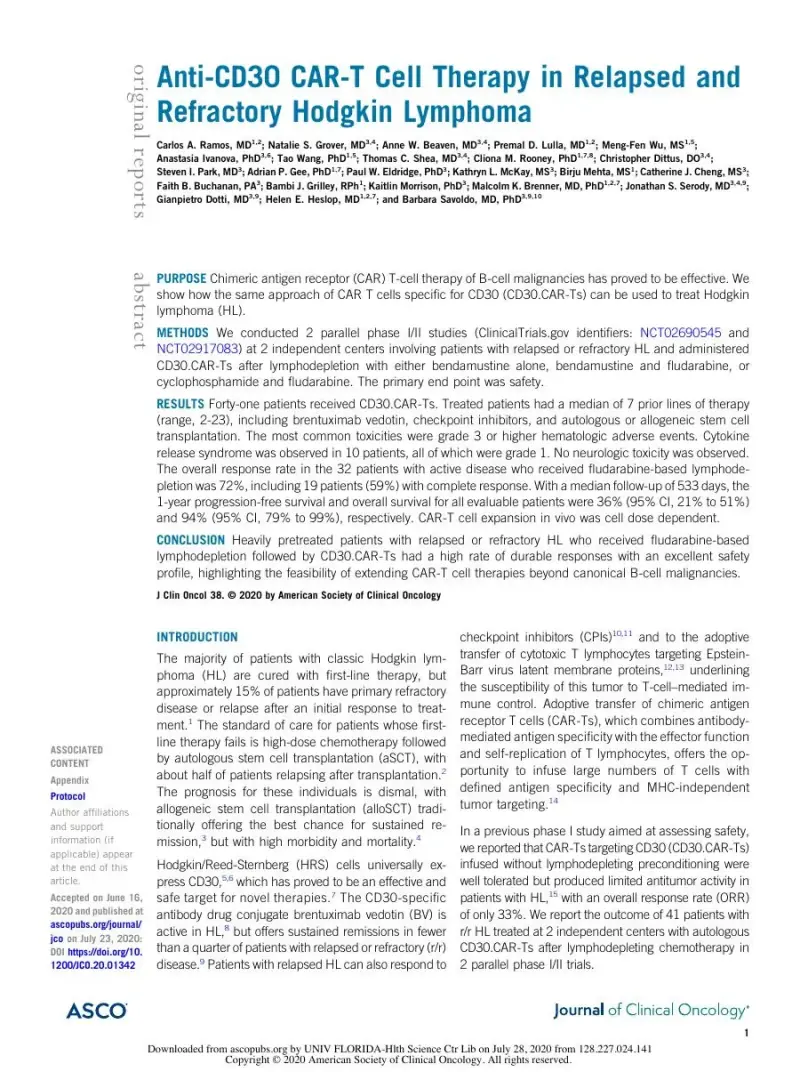
This phase I/II study evaluates autologous CD30 CAR-T cells in relapsed/refractory Hodgkin lymphoma. Fludarabine-based lymphodepletion led to high response rates and durability. The therapy was safe with no neurotoxicity. The study highlights the potential of CD30 CAR-Ts for heavily pretreated patients.
What this paper found
Autologous CD30-specific CAR T cells given after fludarabine-based lymphodepletion produced high and durable response rates in heavily pretreated relapsed or refractory Hodgkin lymphoma. In two parallel phase I/II trials at two US centers, 41 adults received the cells after bendamustine, bendamustine plus fludarabine, or cyclophosphamide plus fludarabine; patients had a median of 7 prior therapies. Among 32 evaluable patients with active disease who received fludarabine-containing regimens, the overall response rate was 72% and 19 (59%) achieved complete response, whereas bendamustine alone produced no objective responses. Cytokine release syndrome occurred in 10 patients, all grade 1, with no neurotoxicity. One-year progression-free survival was 36% and overall survival 94%; CAR-T persistence rose with dose.
Note: Two-center phase I/II study; the authors note that selection bias is possible among patients able to join cell therapy trials and that larger studies are needed to evaluate prolonged cytopenias.
Heavily pretreated patients with relapsed or refractory HL who received fludarabine-based lymphodepletion followed by CD30.CAR-Ts had a high rate of durable responses with an excellent safety profile — Carlos A. Ramos, Natalie S. Grover, Anne W. Beaven, Premal D. Lulla, Meng-Fen Wu, Anastasia Ivanova, Tao Wang, Thomas C. Shea, Cliona M. Rooney, Christopher Dittus, Steven I. Park, Adrian P. Gee, Paul W. Eldridge, Kathryn L. McKay, Birju Mehta, Catherine J. Cheng, Faith B. Buchanan, Bambi J. Grilley, Kaitlin Morrison, Malcolm K. Brenner, Jonathan S. Serody, Gianpietro Dotti, Helen E. Heslop, Barbara Savoldo, Journal of Clinical Oncology
Study details
- Authors
- Carlos A. Ramos, Natalie S. Grover, Anne W. Beaven, Premal D. Lulla, Meng-Fen Wu, Anastasia Ivanova, Tao Wang, Thomas C. Shea, Cliona M. Rooney, Christopher Dittus, Steven I. Park, Adrian P. Gee, Paul W. Eldridge, Kathryn L. McKay, Birju Mehta, Catherine J. Cheng, Faith B. Buchanan, Bambi J. Grilley, Kaitlin Morrison, Malcolm K. Brenner, Jonathan S. Serody, Gianpietro Dotti, Helen E. Heslop, Barbara Savoldo
- Institution
- Center for Cell and Gene Therapy, Baylor College of Medicine, Houston Methodist Hospital and Texas Children's Hospital, Houston, TX, USA · Department of Medicine, Baylor College of Medicine, Houston, TX, USA · Lineberger Comprehensive Cancer Center, University of North Carolina at Chapel Hill, Chapel Hill, NC, USA · Department of Medicine, University of North Carolina at Chapel Hill, Chapel Hill, NC, USA · Biostatistics Shared Resource, Dan L. Duncan Cancer Center, Baylor College of Medicine, Houston, TX, USA · Department of Biostatistics, University of North Carolina at Chapel Hill, Chapel Hill, NC, USA · Department of Pediatrics, Baylor College of Medicine, Houston, TX, USA · Department of Pathology and Immunology, and Molecular Virology and Microbiology, Baylor College of Medicine, Houston, TX, USA · Department of Immunology and Microbiology, University of North Carolina at Chapel Hill, Chapel Hill, NC, USA · Department of Pediatrics, University of North Carolina at Chapel Hill, Chapel Hill, NC, USA
- Journal
- Journal of Clinical Oncology
- Year
- 2020
- Cell type(s)
- CAR T Cells
- Application area
- Hematologic malignancy
Explore related
Full citation
Ramos CA, Grover NS, Beaven AW, et al. Anti-CD30 CAR-T Cell Therapy in Relapsed and Refractory Hodgkin Lymphoma. J Clin Oncol. 2020;38(32):3794-3804.
Building a similar workflow?
Talk to a ScaleReady specialist about how the G-Rex® platform can support your program — from process development to clinical-scale manufacturing.


