
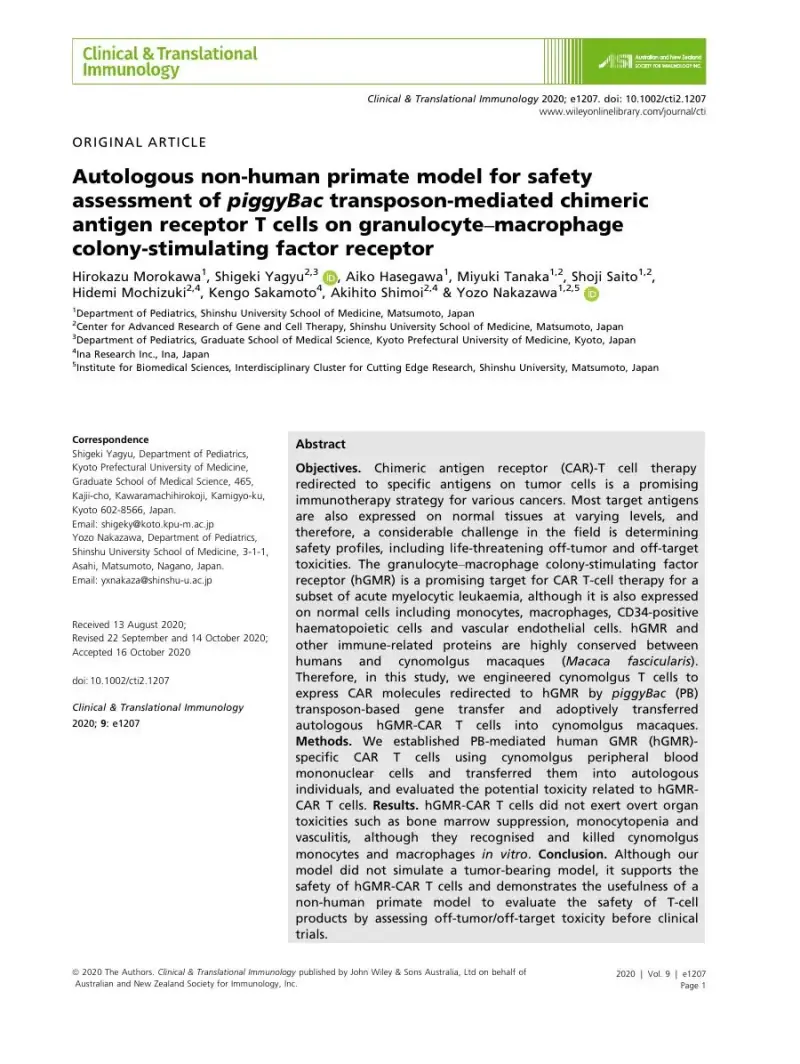
Autologous non-human primate model for safety assessment of piggyBac transposon-mediated chimeric antigen receptor T cells on granulocyte–macrophage colony-stimulating factor receptor
Overview
This study assesses the safety of piggyBac transposon-mediated hGMR-CAR T cells in a non-human primate model. Using G-Rex® for expansion, researchers generated autologous CAR T cells that showed potent killing in vitro and no overt toxicity in vivo, supporting the safety of this approach for clinical trials.
What this paper found
Cynomolgus macaque T cells engineered with a piggyBac transposon to carry a CAR directed at the GM-CSF receptor (hGMR) caused no overt organ toxicity when returned to the same animals. Six macaques were used: three received autologous hGMR-CAR T cells at 3 × 10^5 CAR+ cells per kg and three received control T cells. Although the CAR T cells killed cynomolgus monocytes and M1 macrophages in vitro, monocyte counts, blood counts, coagulation values and tissue pathology showed no CAR-related damage over 14 days. The transgene fell to undetectable levels within a week, and IL-6 rose only transiently and mildly in one animal without symptoms of cytokine release syndrome.
Note: The model did not include tumor-bearing animals; the authors also note that a dose-escalation study is warranted to estimate possible toxicities at higher doses.
The NHP system is a promising tool to evaluate the possible occurrence of unexpected off-tumor/off-target toxicity of cells used in genetically modified immune cell-based therapy — Hirokazu Morokawa, Shigeki Yagyu, Aiko Hasegawa, Miyuki Tanaka, Shoji Saito, Hidemi Mochizuki, Kengo Sakamoto, Akihito Shimoi, Yozo Nakazawa, Clinical & Translational Immunology
Study details
- Authors
- Hirokazu Morokawa, Shigeki Yagyu, Aiko Hasegawa, Miyuki Tanaka, Shoji Saito, Hidemi Mochizuki, Kengo Sakamoto, Akihito Shimoi, Yozo Nakazawa
- Institution
- Department of Pediatrics, Shinshu University School of Medicine, Matsumoto, Japan · Center for Advanced Research of Gene and Cell Therapy, Shinshu University School of Medicine, Matsumoto, Japan · Department of Pediatrics, Graduate School of Medical Science, Kyoto Prefectural University of Medicine, Kyoto, Japan · Ina Research Inc., Ina, Japan · Institute for Biomedical Sciences, Interdisciplinary Cluster for Cutting Edge Research, Shinshu University, Matsumoto, Japan
- Journal
- Clinical & Translational Immunology
- Year
- 2020
- Cell type(s)
- CAR T Cells
- Application area
- Hematologic malignancy
- Study phase
- Preclinical
How G-Rex® was used
Cynomolgus hGMR-CAR T cells were produced from PBMCs by piggyBac electroporation, coculture with autologous immature dendritic cells and culture with IL-7 and IL-15. The cells were then moved to the G-Rex® platform on day 6 and harvested on day 14 for experiments and infusion. Control T cells, activated on anti-CD3/CD28 antibody-coated plates, were also expanded using the G-Rex® platform.
Explore related
Full citation
Morokawa H, Yagyu S, Hasegawa A, et al. Autologous non-human primate model for safety assessment of piggyBac transposon-mediated chimeric antigen receptor T cells on granulocyte–macrophage colony-stimulating factor receptor. Clin Transl Immunology. 2020;9(11):e1207.
Building a similar workflow?
Talk to a ScaleReady specialist about how the G-Rex® platform can support your program — from process development to clinical-scale manufacturing.


