
A multivariate, quantitative assay that disentangles key kinetic parameters of primary human T cell function in vitro
Overview
The authors developed the QuIK assay to measure proliferation and killing kinetics of engineered T cells. Primary human T cells were transduced and expanded in 24-well G-Rex® plates. The assay provides detailed insights into the functional biology of CAR-T and TCR-T cells over time.
What this paper found
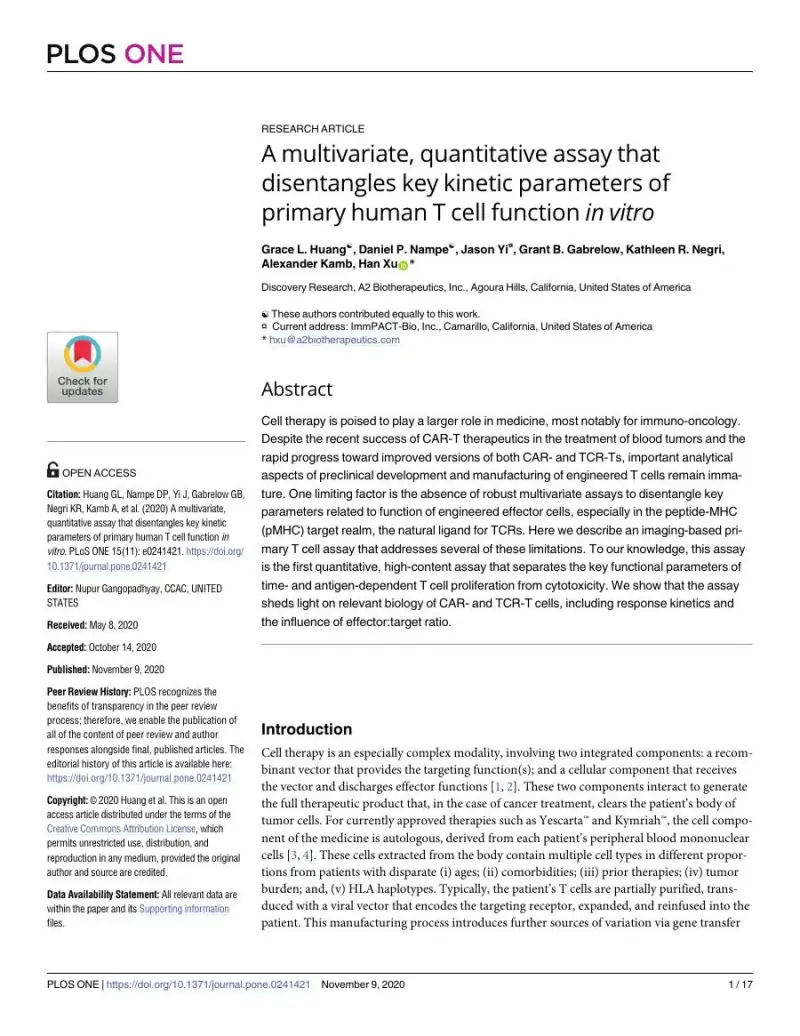
The Quantitative Imaging-based Killing (QuIK) assay tracks primary human CAR-T and TCR-T cells cocultured with peptide-loaded A375 target cells in an IncuCyte imager. It separates antigen-dependent T cell proliferation from specific killing over time, using three dyes and per-cell rate calculations. Three HPV-directed receptors were compared at E:T ratios of 3:1, 1:1 and 1:3. Proliferation peaked at 72 hours and killing at 48 hours. The maximum kill rate occurred at about 24 hours for all constructs. Maximum killing fell at lower E:T ratios, while T cells proliferated more when cytotoxicity was lower. The HPV E7 CAR showed neither specific killing nor proliferation and had high tonic activation, which conventional assays did not clearly reveal.
Note: The QuIK assay cannot measure baseline or tonic signaling, and the data are limited to a small set of CARs and TCRs.
To our knowledge, this assay is the first quantitative, high-content assay that separates the key functional parameters of time- and antigen-dependent T cell proliferation from cytotoxicity. — Grace L. Huang, Daniel P. Nampe, Jason Yi, Grant B. Gabrelow, Kathleen R. Negri, Alexander Kamb, Han Xu, PLOS ONE
Study details
- Authors
- Grace L. Huang, Daniel P. Nampe, Jason Yi, Grant B. Gabrelow, Kathleen R. Negri, Alexander Kamb, Han Xu
- Institution
- Discovery Research, A2 Biotherapeutics, Inc., Agoura Hills, California, United States of America · ImmPACT-Bio, Inc., Camarillo, California, United States of America
- Journal
- PLOS ONE
- Year
- 2020
- G-Rex® model(s)
- G-Rex®24 Well Plate
- Cell type(s)
- CAR T Cells, TCR T Cells
- Application area
- Solid tumor
- Study phase
- Preclinical
How G-Rex® was used
Primary human PBMCs were activated with TransAct on day 0 in a 24-well plate and transduced with lentivirus encoding a CAR or TCR on day 1. On day 5 the cells were resuspended in 3 mL LymphoONE medium with IL2 (300 IU/mL) and moved to a 24-well G-Rex® plate (Wilson Wolf 80192M). On day 7, 1 mL of medium with IL2 was added. After day 9 enrichment of CAR- or TCR-positive cells with Anti-PE microbeads, cells were resuspended in 3 mL medium with IL2 and returned to a 24-well G-Rex®. Fresh IL2 was added every 48 hours, with a media change every 7 days.
Explore related

Full citation
Huang GL, Nampe DP, Yi J, et al. A multivariate, quantitative assay that disentangles key kinetic parameters of primary human T cell function in vitro. PLoS One. 2020;15(11):e0241421.
Building a similar workflow?
Talk to a ScaleReady specialist about how the G-Rex® platform can support your program — from process development to clinical-scale manufacturing.


