
Photodepletion with 2-Se-Cl prevents lethal graft-versus-host disease while preserving antitumor immunity
Overview
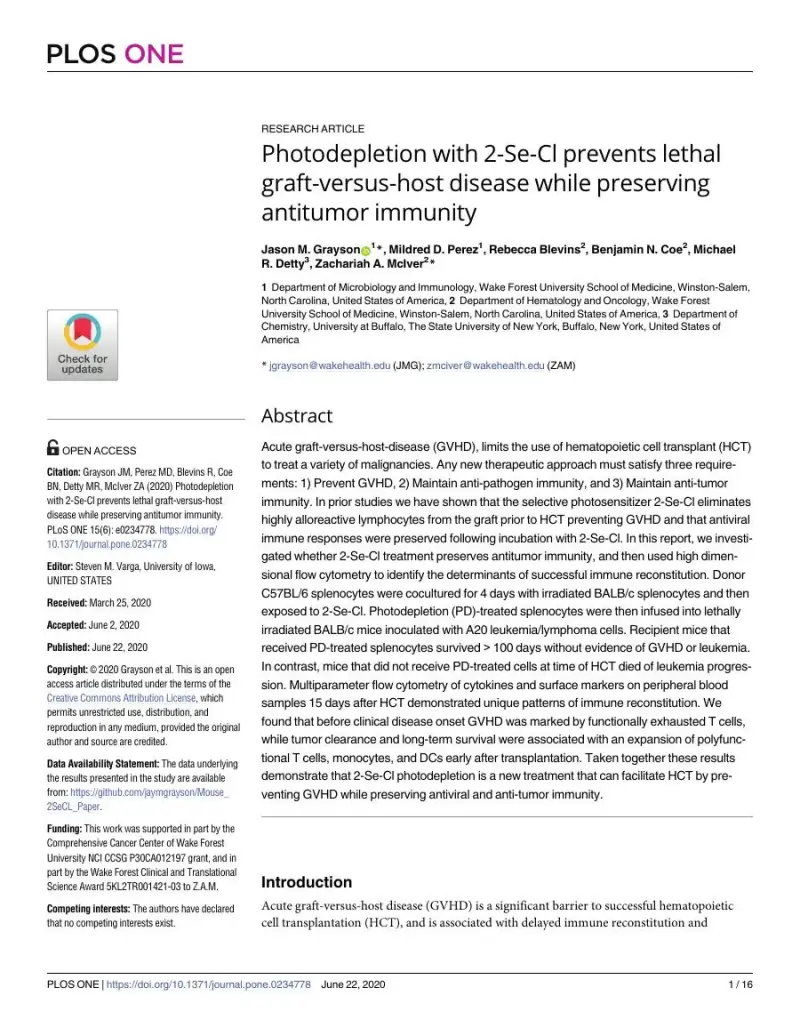
This research demonstrates that photodepletion with 2-Se-Cl selectively removes alloreactive T cells to prevent GVHD without compromising antitumor immunity. G-Rex® devices were utilized for the initial co-culture and priming of splenocytes before the photodepletion step.
What this paper found
Ex vivo photodepletion of alloprimed donor splenocytes with the photosensitizer 2-Se-Cl prevented lethal graft-versus-host disease while keeping antileukemic activity in a fully MHC-mismatched mouse transplant model. BALB/c recipients given T cell-depleted bone marrow, A20 leukemia cells and 5 × 10^6 photodepleted cells survived beyond 100 days with no GVHD or leukemia. Mice given no T cells died of leukemia at a mean of 21 days, and those given untreated primed splenocytes died of GVHD at a mean of 25 days. Post-transplant cyclophosphamide did not prevent lethal GVHD (mean 37 days). Flow cytometry 15 days after transplant linked GVHD to exhausted T cells and long-term survival to polyfunctional T cells, monocytes and dendritic cells.
Note: Mouse study in a single model of lethal GVHD with an aggressive leukemia; the authors note that studies in humans are required to confirm the results.
Employing 2-Se-Cl is superior to the application of PTCy for GVHD prophylaxis in our model. — Jason M. Grayson, Mildred D. Perez, Rebecca Blevins, Benjamin N. Coe, Michael R. Detty, Zachariah A. McIver, PLOS ONE
Study details
- Authors
- Jason M. Grayson, Mildred D. Perez, Rebecca Blevins, Benjamin N. Coe, Michael R. Detty, Zachariah A. McIver
- Institution
- Department of Microbiology and Immunology, Wake Forest University School of Medicine, Winston-Salem, North Carolina, United States of America · Department of Hematology and Oncology, Wake Forest University School of Medicine, Winston-Salem, North Carolina, United States of America · Department of Chemistry, University at Buffalo, The State University of New York, Buffalo, New York, United States of America
- Journal
- PLOS ONE
- Year
- 2020
- Cell type(s)
- T-Cells
- Application area
- Hematologic malignancy
- Study phase
- Preclinical
How G-Rex® was used
A Gas-permeable Rapid Expansion device (G-Rex®) was used to prepare the primed splenocyte product for photodepletion. Donor C57BL/6 splenocytes were co-cultured in the G-Rex® for 4 days with irradiated (20 Gy) BALB/c splenocytes. The primed cells were then photodepleted with 2-Se-Cl and infused at 5 × 10^6 cells into irradiated BALB/c recipients along with T cell-depleted bone marrow and A20 leukemia cells.
Full citation
Grayson JM, Perez MD, Blevins R, Coe BN, Detty MR, McIver ZA. Photodepletion with 2-Se-Cl prevents lethal graft-versus-host disease while preserving antitumor immunity. PLoS One. 2020;15(6):e0234778.
Building a similar workflow?
Talk to a ScaleReady specialist about how the G-Rex® platform can support your program — from process development to clinical-scale manufacturing.


