
Generation of Antitumor T Cells For Adoptive Cell Therapy With Artificial Antigen Presenting Cells
Overview
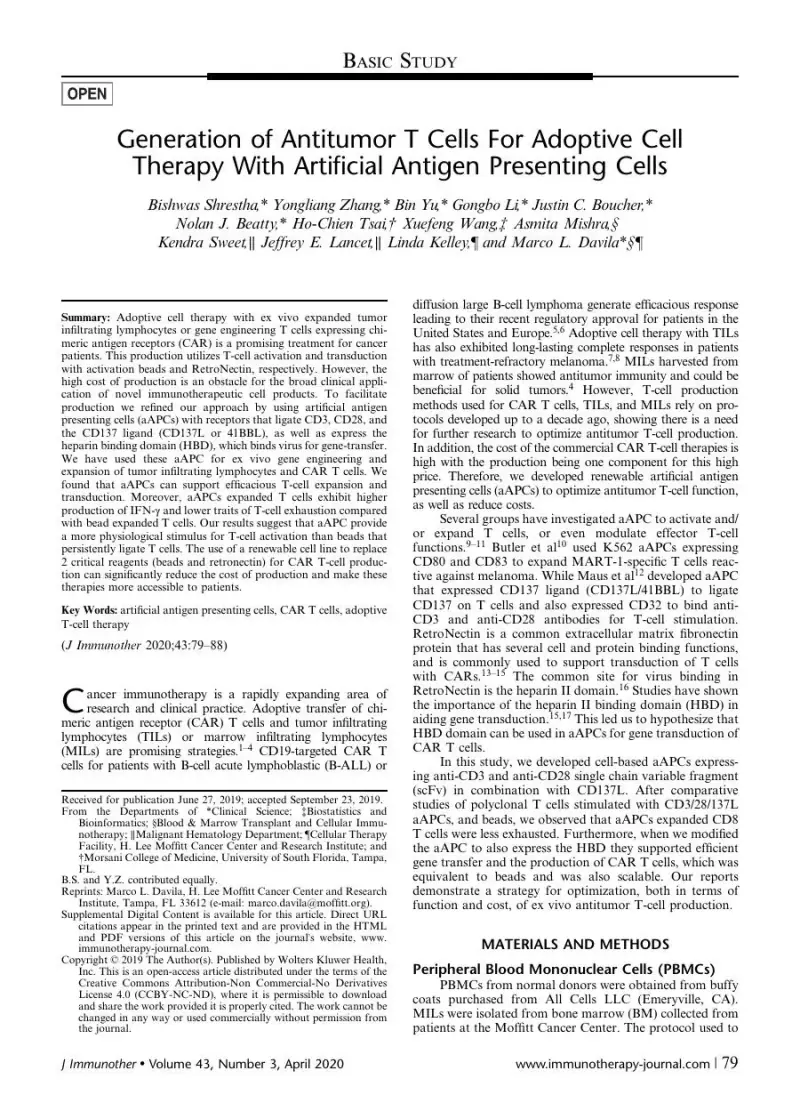
This study develops renewable artificial antigen presenting cells (aAPCs) for T cell expansion and transduction. Using G-Rex® , aAPCs supported efficient production of CAR T cells and TILs with less exhaustion and higher potency than bead-based methods, offering a cost-effective manufacturing alternative.
What this paper found
Cell-based artificial antigen presenting cells (aAPCs) made from K562 cells expressing anti-CD3, anti-CD28 and CD137L expanded human T cells more effectively than antibody-coated beads. In healthy donor T cells cultured for 14 days in G-Rex® flasks, mean CD3 T-cell fold expansion was 348 with aAPCs versus 106 with CD3/28/137L beads, and in bone marrow T cells from AML patients it was 344 versus 114. Tumor infiltrating lymphocytes activated with CD137L-bearing aAPCs showed lower PD-1 and CTLA-4 than those with CD3/28 aAPCs. Adding a heparin binding domain let aAPCs support CAR retroviral transduction, and a scaled-up CD33 CAR T-cell run reached 2 × 10^8 cells with cytotoxicity comparable to beads.
Note: The authors state that the K562 aAPCs are being made GMP compliant for clinical use; the work reported is in vitro.
Our results suggest that aAPC provide a more physiological stimulus for T-cell activation than beads that persistently ligate T cells. — Bishwas Shrestha, Yongliang Zhang, Bin Yu, Gongbo Li, Justin C. Boucher, Nolan J. Beatty, Ho-Chien Tsai, Xuefeng Wang, Asmita Mishra, Kendra Sweet, Jeffrey E. Lancet, Linda Kelley, Marco L. Davila, Journal of Immunotherapy
Study details
- Authors
- Bishwas Shrestha, Yongliang Zhang, Bin Yu, Gongbo Li, Justin C. Boucher, Nolan J. Beatty, Ho-Chien Tsai, Xuefeng Wang, Asmita Mishra, Kendra Sweet, Jeffrey E. Lancet, Linda Kelley, Marco L. Davila
- Institution
- Department of Clinical Science, H. Lee Moffitt Cancer Center and Research Institute, Tampa, FL, USA · Department of Biostatistics and Bioinformatics, H. Lee Moffitt Cancer Center and Research Institute, Tampa, FL, USA · Department of Blood & Marrow Transplant and Cellular Immunotherapy, H. Lee Moffitt Cancer Center and Research Institute, Tampa, FL, USA · Malignant Hematology Department, H. Lee Moffitt Cancer Center and Research Institute, Tampa, FL, USA · Cellular Therapy Facility, H. Lee Moffitt Cancer Center and Research Institute, Tampa, FL, USA · Morsani College of Medicine, University of South Florida, Tampa, FL, USA
- Journal
- Journal of Immunotherapy
- Year
- 2019
- Cell type(s)
- CAR T Cells, T-Cells, TIL Cells
- Application area
- Hematologic malignancy · Solid tumor
- Study phase
- Preclinical
How G-Rex® was used
Healthy donor and AML bone marrow T cells were cocultured in G-Rex® flasks for two weeks in serum-free medium with K562 CD3/28/137L aAPCs added once at a 3:1 ratio or with beads at 1:1; expansion was measured by flow cytometry. In CAR T-cell production, cells transduced for 7 days were expanded for a further 7 days in G-Rex® flasks with beads or irradiated (10 Gy) K562 CD3/28/137L aAPCs. In the scaled-up CD33 CAR run, 1 million CAR T cells were expanded in G-Rex® for 7 days, with aAPCs yielding more cells than beads (2 × 10^8 cells).
Explore related
Full citation
Shrestha B, Zhang Y, Yu B, et al. Generation of Antitumor T Cells For Adoptive Cell Therapy With Artificial Antigen Presenting Cells. J Immunother. 2020;43(3):79-88.
Building a similar workflow?
Talk to a ScaleReady specialist about how the G-Rex® platform can support your program — from process development to clinical-scale manufacturing.


