Rapidly expanded partially HLA DRB1–matched fungus-specific T cells mediate in vitro and in vivo antifungal activity
Overview
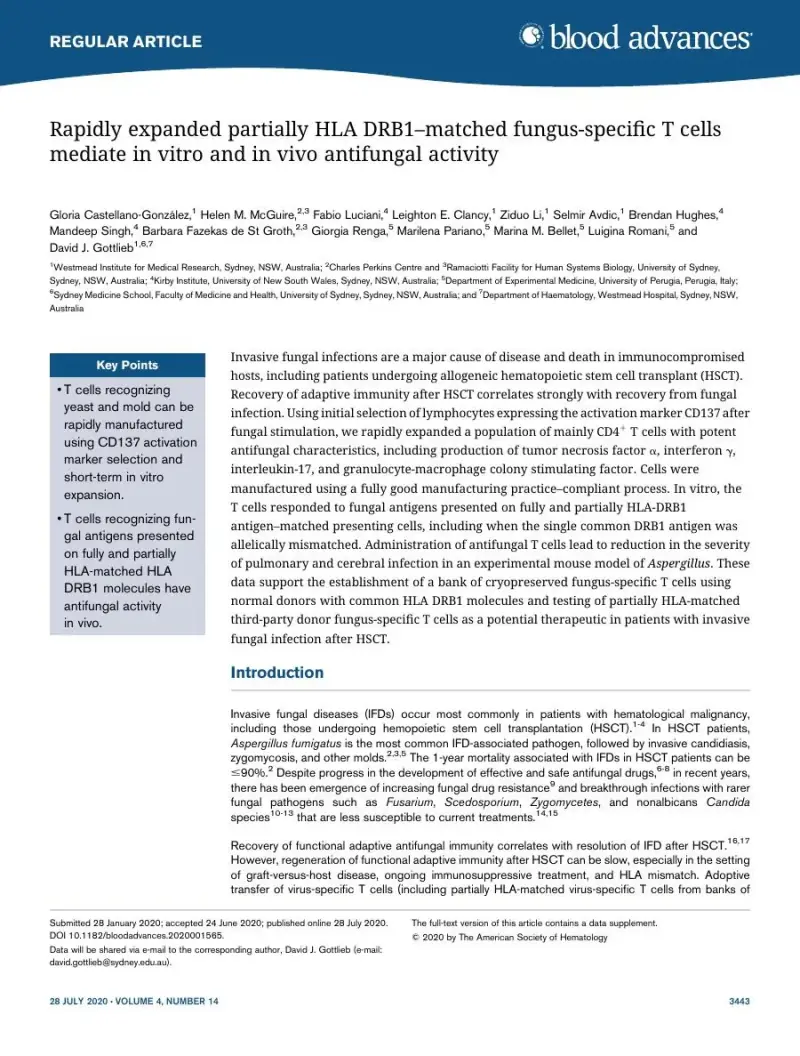
The authors describe a GMP-compliant method to rapidly expand fungus-specific T cells using CD137 selection and short-term culture. G-Rex® cell culture plates were used for the in vitro expansion of the enriched CD137+ population. The resulting T cells demonstrated potent antifungal activity against Aspergillus.
What this paper found
Fungus-specific T cells can be manufactured within 11 days from healthy donor stem cell apheresis products by selecting CD137-positive cells after fungal lysate stimulation and expanding them in vitro. Selected cells grew from about 0.07 to 0.1 × 10^6 to roughly 103 to 148 × 10^6 over the culture, more than 1000-fold, and were mainly CD4-positive. The process is good manufacturing practice–compliant. Cells made with A terreus and C krusei lysates responded to dendritic cells sharing only one HLA-DR molecule, even with an allele subtype mismatch, though less strongly than with full matching (12.4% and 9.9% versus 35.7% TNF-α-producing CD4 cells). In humanized NSG mice infected with Aspergillus fumigatus, infusing 10^6 panfungal T cells reduced fungal burden in lung and brain and lessened lung inflammation.
Note: Evidence comes from in vitro assays and a humanized mouse model; the authors propose that testing of partially HLA-matched third-party fungus-specific T cells in patients after HSCT is the next step.
Fungal recognition was mediated mainly via HLA-DR and was maintained in the setting of partial HLA DR matching. — Gloria Castellano-González, Helen M. McGuire, Fabio Luciani, Leighton E. Clancy, Ziduo Li, Selmir Avdic, Brendan Hughes, Mandeep Singh, Barbara Fazekas de St Groth, Giorgia Renga, Marilena Pariano, Marina M. Bellet, Luigina Romani, David J. Gottlieb, Blood Advances
Study details
- Authors
- Gloria Castellano-González, Helen M. McGuire, Fabio Luciani, Leighton E. Clancy, Ziduo Li, Selmir Avdic, Brendan Hughes, Mandeep Singh, Barbara Fazekas de St Groth, Giorgia Renga, Marilena Pariano, Marina M. Bellet, Luigina Romani, David J. Gottlieb
- Institution
- Westmead Institute for Medical Research, Sydney, NSW, Australia · Charles Perkins Centre, University of Sydney, Sydney, NSW, Australia · Ramaciotti Facility for Human Systems Biology, University of Sydney, Sydney, NSW, Australia · Kirby Institute, University of New South Wales, Sydney, NSW, Australia · Department of Experimental Medicine, University of Perugia, Perugia, Italy · Sydney Medicine School, Faculty of Medicine and Health, University of Sydney, Sydney, NSW, Australia · Department of Haematology, Westmead Hospital, Sydney, NSW, Australia
- Journal
- Blood Advances
- Year
- 2020
- Cell type(s)
- Other
- Application area
- Infectious disease
- Study phase
- Preclinical
How G-Rex® was used
CD137-selected fungus-specific T cells, which numbered roughly 0.06 to 0.1 × 10^6, were resuspended in complete AIM-V medium and plated in a G-Rex® cell culture plate. The irradiated CD137-negative fraction (30 Gy) was cocultured with them in AIM-V with 20 U/mL IL-2, 200 U/mL IL-7 and 200 U/mL IL-15 at 37°C and 5% CO2, with cytokines replenished every 2 or 3 days. Cultures ran 11 to 12 days, or up to about 20 days when restimulated. Cell numbers rose to 103 to 148 × 10^6 at day 11, and C krusei plus A terreus cultures reached about 3234 × 10^6 after restimulation.
Explore related
Full citation
Castellano-González G, McGuire HM, Luciani F, et al. Rapidly expanded partially HLA DRB1–matched fungus-specific T cells mediate in vitro and in vivo antifungal activity. Blood Adv. 2020;4(14):3443-3456.
Building a similar workflow?
Talk to a ScaleReady specialist about how the G-Rex® platform can support your program — from process development to clinical-scale manufacturing.