
Production of Lentiviral Vectors Using Suspension Cells Grown in Serum-free Media
Overview
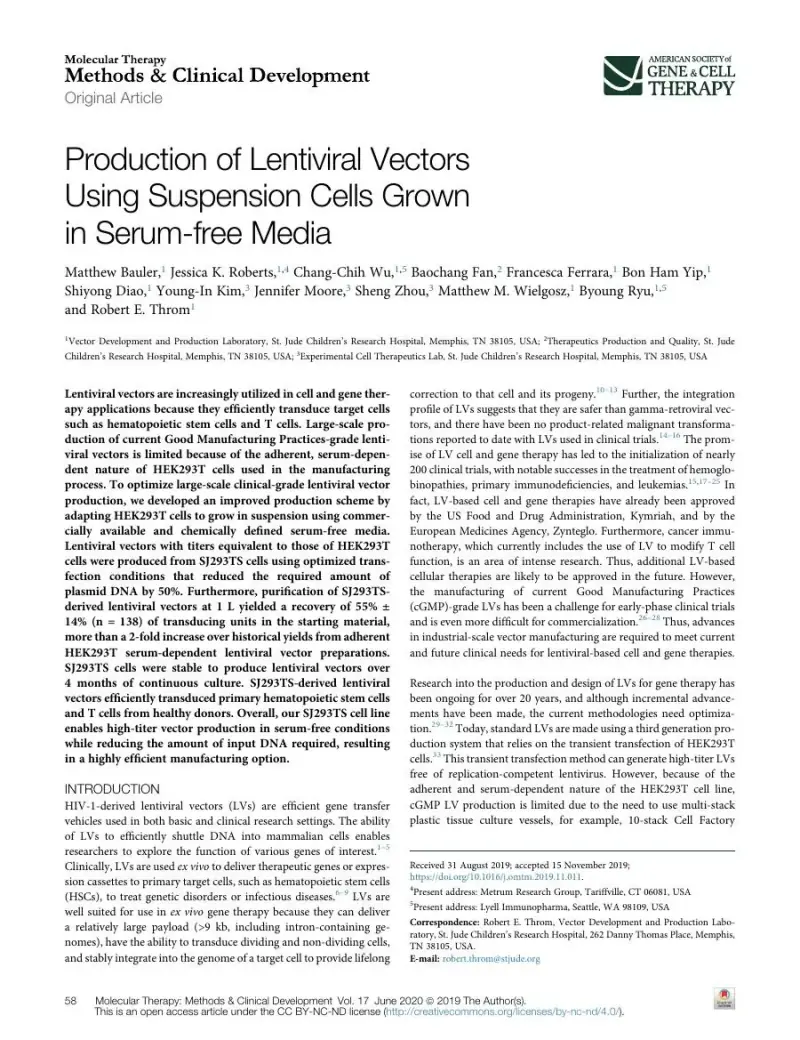
The authors developed a scalable, serum-free process for lentiviral vector production using suspension-adapted SJ293TS cells. The vectors efficiently transduced human T cells and CD34+ cells. G-Rex® plates were employed to expand the transduced T cells for assessing chimeric antigen receptor expression and titer.
What this paper found
Adapting HEK293T cells to suspension growth in commercial serum-free medium yielded SJ293TS cells, which produce lentiviral vectors at titers comparable to adherent HEK293T cells while using half the plasmid DNA. In the first 1-L comparisons, HEK293T titers were 1.4- to 2-fold higher, but in a later 1-L comparison SJ293TS gave 1.8-fold more vector than HEK293T cells in Cell Factory systems. Purifying 138 one-liter preparations recovered 55% ± 14% of transducing units, about twice historical adherent yields of 16% to 33%. The line produced vector stably over 4 months of culture, and its vectors efficiently transduced healthy-donor T cells and CD34+ cells. With BaEV-R-less glycoprotein, SJ293TS cells gave 20-fold more transducing units than HEK293T at equal DNA input.
Note: Production was shown at the 1-L scale in shaker flasks; the authors state that future work will demonstrate the 5-L scale in a stirred-tank bioreactor.
Overall, our SJ293TS cell line enables high-titer vector production in serum-free conditions while reducing the amount of input DNA required, resulting in a highly efficient manufacturing option. — Matthew Bauler, Jessica K. Roberts, Chang-Chih Wu, Baochang Fan, Francesca Ferrara, Bon Ham Yip, Shiyong Diao, Young-In Kim, Jennifer Moore, Sheng Zhou, Matthew M. Wielgosz, Byoung Ryu, Robert E. Throm, Molecular Therapy - Methods & Clinical Development
Study details
- Authors
- Matthew Bauler, Jessica K. Roberts, Chang-Chih Wu, Baochang Fan, Francesca Ferrara, Bon Ham Yip, Shiyong Diao, Young-In Kim, Jennifer Moore, Sheng Zhou, Matthew M. Wielgosz, Byoung Ryu, Robert E. Throm
- Institution
- Vector Development and Production Laboratory, St. Jude Children's Research Hospital, Memphis, TN, USA · Therapeutics Production and Quality, St. Jude Children's Research Hospital, Memphis, TN, USA · Experimental Cell Therapeutics Lab, St. Jude Children's Research Hospital, Memphis, TN, USA
- Journal
- Molecular Therapy - Methods & Clinical Development
- Year
- 2019
- Cell type(s)
- CAR T Cells, CD34 Cells
- Application area
- Other
- Study phase
- Preclinical
How G-Rex® was used
Healthy-donor CD4+ and CD8+ T cells were purified with the CliniMACS system, activated with T Cell TransAct in six-well plates for 24 h, and transduced with four SJ293TS-derived anti-CD123 CAR lentiviral vector batches at an MOI of 25 in 1 mL. After 22 h of transduction, the cells were transferred to a G-Rex® plate and cultured in 30 mL of X-VIVO 15 with 5% human AB serum and 10 ng/mL IL-7 and IL-15. CAR expression, viability and expansion were then assessed, and all four T cell populations expressed high levels of CAR with expansion and viability comparable to mock-transduced cells.
Explore related
Full citation
Bauler M, Roberts JK, Wu CC, et al. Production of Lentiviral Vectors Using Suspension Cells Grown in Serum-free Media. Mol Ther Methods Clin Dev. 2019;17:58-68.
Building a similar workflow?
Talk to a ScaleReady specialist about how the G-Rex® platform can support your program — from process development to clinical-scale manufacturing.


