
Closing the system: production of viral antigen-presenting dendritic cells eliciting specific CD8+ T cell activation in fluorinated ethylene propylene cell culture bags
Overview
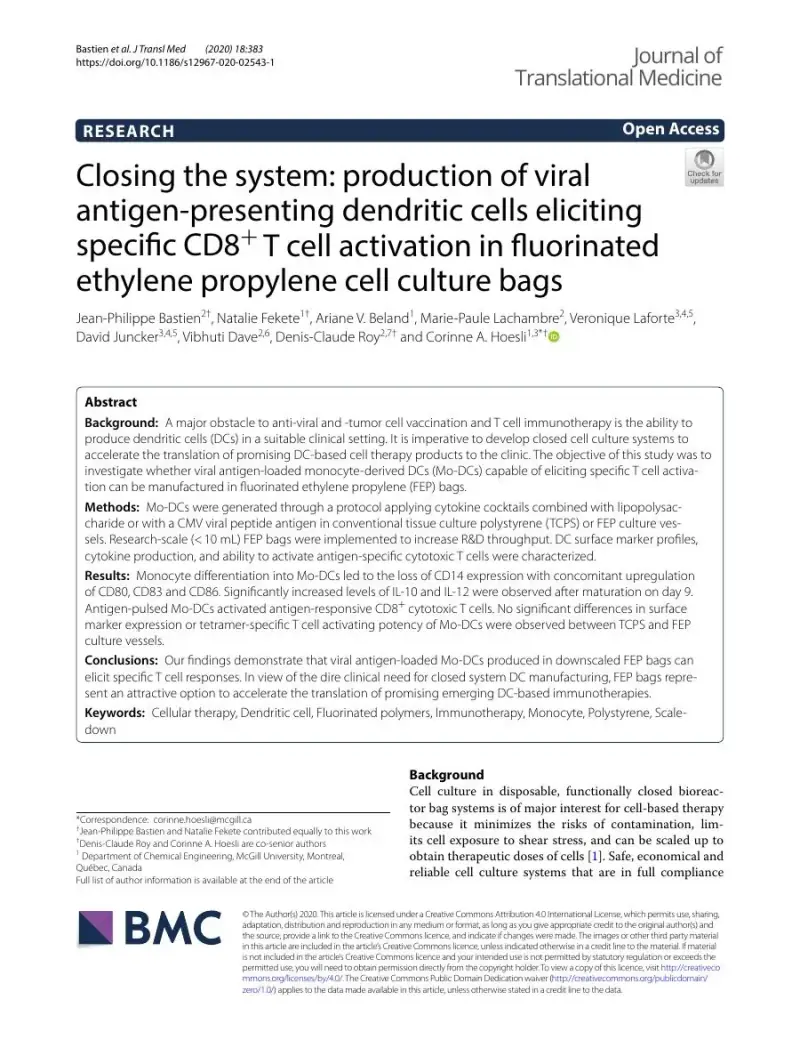
This study compares monocyte-derived dendritic cell (Mo-DC) production in fluorinated ethylene propylene bags versus polystyrene plates. Mo-DCs generated in bags showed comparable phenotype and ability to activate T cells. G-Rex® were utilized for the T cell co-culture steps to assess activation potency.
What this paper found
Monocyte-derived dendritic cells loaded with a cytomegalovirus peptide and produced in closed fluorinated ethylene propylene (FEP) culture bags activated antigen-specific CD8+ T cells as effectively as cells made in conventional polystyrene plates. Monocytes from healthy donors were differentiated and matured in 1, 2 or 7 mL FEP bags or 24-well polystyrene plates. Surface markers, with CD14 lost and CD80, CD83 and CD86 upregulated, and IL-10 and IL-12 release did not differ significantly between vessels. Autologous T cells (15 × 10^6) were co-cultured for 14 days with NLV-pulsed dendritic cells, and the tetramer-specific CD8+ T cells showed comparable frequency and CD25 activation irrespective of the vessel used to make the dendritic cells. Viability was lower in 1 mL bags than in 2 mL bags (p = 0.02).
Note: In vitro study using research-scale FEP bags of under 10 mL working volume.
Our findings demonstrate that viral antigen-loaded Mo-DCs produced in downscaled FEP bags can elicit specific T cell responses. — Jean-Philippe Bastien, Natalie Fekete, Ariane V. Beland, Marie-Paule Lachambre, Veronique Laforte, David Juncker, Vibhuti Dave, Denis-Claude Roy, Corinne A. Hoesli, Journal of Translational Medicine
Study details
- Authors
- Jean-Philippe Bastien, Natalie Fekete, Ariane V. Beland, Marie-Paule Lachambre, Veronique Laforte, David Juncker, Vibhuti Dave, Denis-Claude Roy, Corinne A. Hoesli
- Institution
- Department of Chemical Engineering, McGill University, Montreal, Québec, Canada · Hematology-Oncology and Cell Therapy Institute, Hopital Maisonneuve-Rosemont Research Center, Montreal, Québec, Canada · Department of Biomedical Engineering, McGill University, Montreal, Québec, Canada · McGill Genome Centre, McGill University, Montreal, Québec, Canada · Department of Neurology and Neurosurgery, McGill University, Montreal, Québec, Canada · Department of Microbiology, Infectiology and Immunology, Université de Montréal, Montreal, Québec, Canada · Department of Medicine, Université de Montréal, Montreal, Québec, Canada
- Journal
- Journal of Translational Medicine
- Year
- 2020
- G-Rex® model(s)
- G-Rex®10
- Cell type(s)
- CTL Cells, DC Cells
- Application area
- Other
- Study phase
- Preclinical
How G-Rex® was used
Autologous T cells (15 × 10^6) from the CD14-negative fraction were co-cultured with irradiated unpulsed or CMV NLV peptide-pulsed monocyte-derived dendritic cells in G-Rex® 10 bioreactors for 14 days. During the first 7 days the RPMI-based medium contained IL-21, IL-12 and IL-2. At day 7 the T cells were restimulated with fresh dendritic cells and suspended in new medium containing IL-21, IL-15, IL-7 and IL-2. T cells were counted at days 0, 7 and 14, and tetramer-specific CD8+ T cells were assessed at day 14.
Explore related

Full citation
Bastien JP, Fekete N, Beland AV, et al. Closing the system: production of viral antigen-presenting dendritic cells eliciting specific CD8+ T cell activation in fluorinated ethylene propylene cell culture bags. J Transl Med. 2020;18(1):383.
Building a similar workflow?
Talk to a ScaleReady specialist about how the G-Rex® platform can support your program — from process development to clinical-scale manufacturing.


