
Enhanced Bone Marrow Homing of Natural Killer Cells Following mRNA Transfection With Gain-of-Function Variant CXCR4R334X
Overview
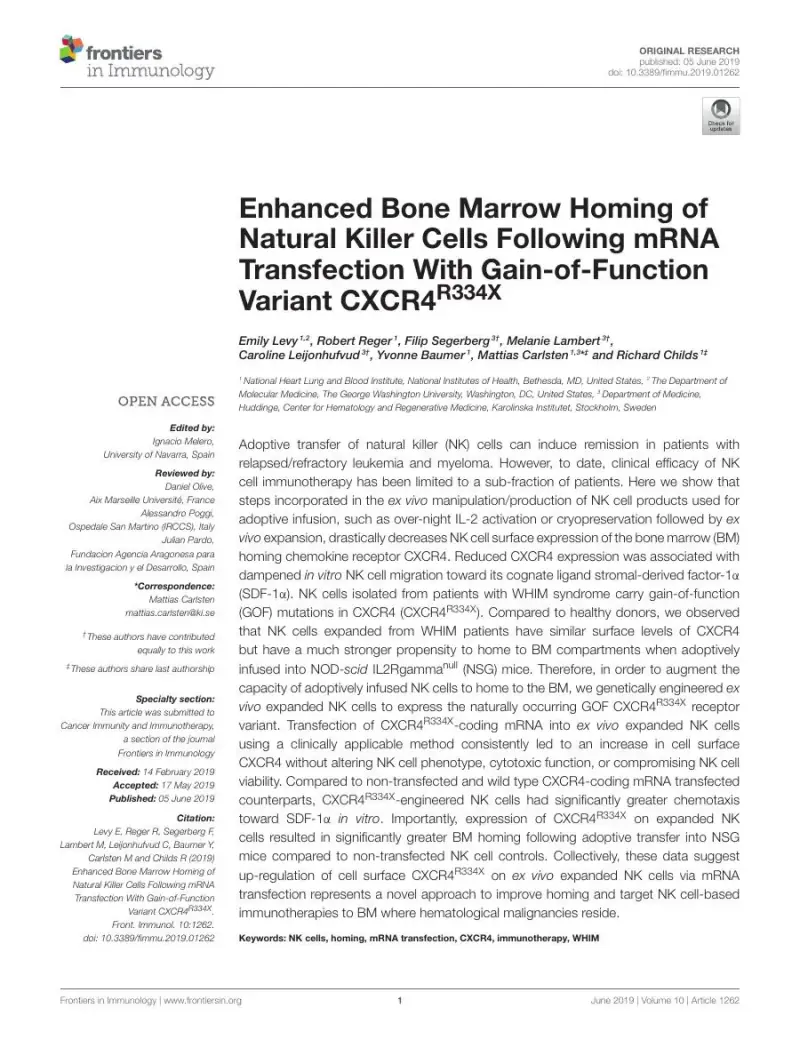
This study enhanced NK cell bone marrow homing by transfecting them with a CXCR4 variant. NK cells were expanded ex vivo for 14-18 days in G-Rex® with feeder cells, providing a robust platform for generating cells for genetic modification.
What this paper found
Introducing the gain-of-function CXCR4 variant R334X into expanded human NK cells by mRNA electroporation improved their homing to bone marrow in mice. Overnight IL-2 activation, cryopreservation and ex vivo expansion lowered CXCR4 on NK cells and reduced migration toward SDF-1α in vitro. NK cells expanded from three WHIM syndrome patients, who carry CXCR4 R334X, showed similar CXCR4 surface levels yet homed much more strongly to NSG mouse bone marrow. Electroporation with a MaxCyte GT instrument raised CXCR4 transiently, peaking 4–8 h and returning to baseline by 36–48 h, without changing viability, phenotype or cytotoxicity. R334X-engineered cells migrated better toward 25 and 50 ng/mL SDF-1α than wild-type-mRNA or control cells and were enriched in femur bone marrow 24 h after infusion (p = 0.0153).
Note: Homing was tested in a xenogeneic mouse model; the authors note that clinical studies are still needed to validate the findings in humans.
Somewhat unexpectedly, we observed that electroporation of NK cells resulting in a substantial increase in surface WT CXCR4 did not augment their migration capacity to SDF-1α. — Emily Levy, Robert Reger, Filip Segerberg, Melanie Lambert, Caroline Leijonhufvud, Yvonne Baumer, Mattias Carlsten, Richard Childs, Frontiers in Immunology
Study details
- Authors
- Emily Levy, Robert Reger, Filip Segerberg, Melanie Lambert, Caroline Leijonhufvud, Yvonne Baumer, Mattias Carlsten, Richard Childs
- Institution
- National Heart Lung and Blood Institute, National Institutes of Health, Bethesda, MD, United States · The Department of Molecular Medicine, The George Washington University, Washington, DC, United States · Department of Medicine, Huddinge, Center for Hematology and Regenerative Medicine, Karolinska Institutet, Stockholm, Sweden
- Journal
- Frontiers in Immunology
- Year
- 2019
- Cell type(s)
- NK Cells
- Application area
- Hematologic malignancy
- Study phase
- Preclinical
How G-Rex® was used
Healthy donor NK cells, isolated from PBMCs by magnetic bead separation, were expanded for 14–18 days in G-Rex® flasks with irradiated human EBV-LCL feeder cells at one NK cell to 10 feeder cells. Cells were cultured in X-vivo 20 medium with 10% human AB serum, 1% Glutamax and 500 U/ml IL-2. Fresh medium was supplied from day 5 of expansion and then every 48 h until harvest. NK cells from WHIM patients and healthy donors used in the mouse homing study were expanded for 19 days with irradiated EBV-LCL feeders, and the expanded cells were then used for mRNA electroporation and functional assays.
Explore related
Full citation
Levy E, Reger R, Segerberg F, et al. Enhanced Bone Marrow Homing of Natural Killer Cells Following mRNA Transfection With Gain-of-Function Variant CXCR4R334X. Front Immunol. 2019;10:1262.
Building a similar workflow?
Talk to a ScaleReady specialist about how the G-Rex® platform can support your program — from process development to clinical-scale manufacturing.


