
Leukoreduction system chambers are a reliable cellular source for the manufacturing of T-cell therapeutics
Overview
This study validates leukoreduction system chambers as a source of PBMCs for T cell therapy. G-Rex® culture vessels were used to generate and expand pathogen-specific T cell lines, showing they are equivalent to those derived from peripheral blood.
What this paper found
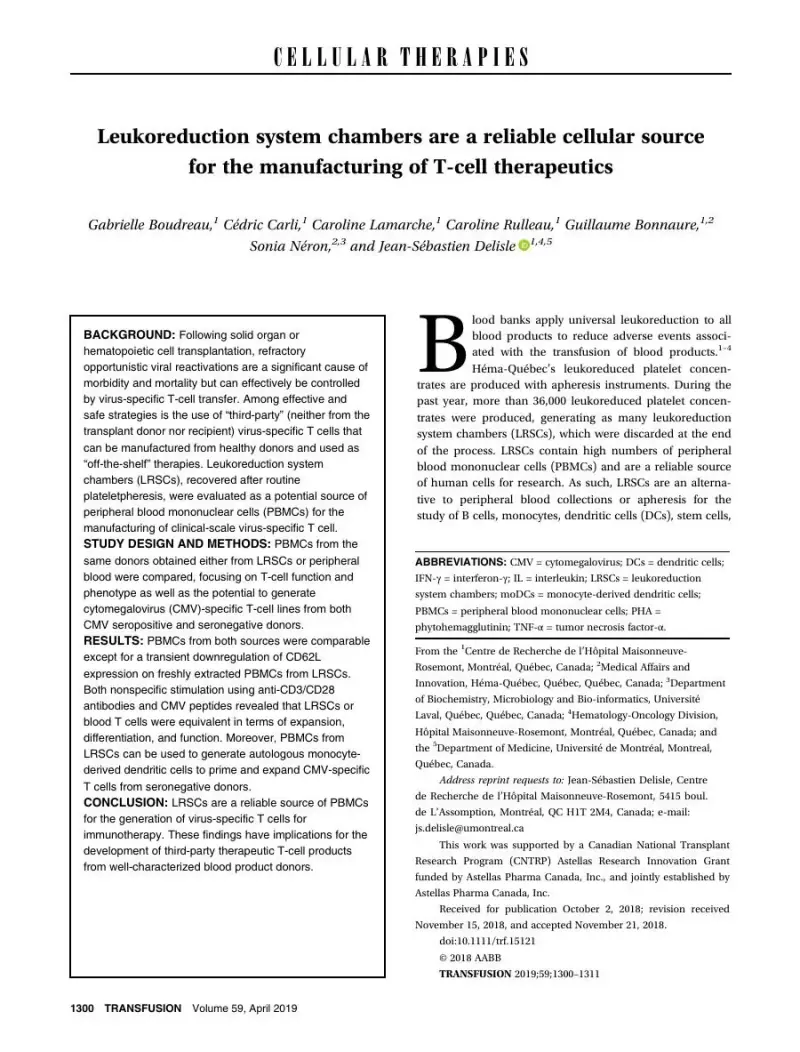
Leukoreduction system chambers (LRSCs) discarded after plateletpheresis supply peripheral blood mononuclear cells (PBMCs) that perform like paired blood samples for manufacturing virus-specific T cells. Each LRSC gave about 1.3 billion PBMCs, and T-cell subsets in five donors matched blood, except for transiently lower CD62L on fresh LRSC cells. After anti-CD3/CD28 stimulation, T cells expanded 6.6-fold from LRSCs and 5.9-fold from blood after 7 days in culture. Cultures of 15 × 10^6 PBMCs with CMV pp65 peptides grew 6.7-fold (LRSC) and 5.1-fold (blood) over 14 days, and fresh and cryopreserved cells performed comparably. LRSC-derived dendritic cells also primed CMV-specific T cells from seronegative donors, yielding an average of 57 million cells.
Note: In vitro study; the authors note that not all T-cell lines showed strong effector function, with variability between donors.
Overall, our work shows that LRSCs are a reliable source of PBMCs for the manufacturing of clinical scale T-cell therapies from memory and naïve T-cell repertoires. — Gabrielle Boudreau, Cédric Carli, Caroline Lamarche, Caroline Rulleau, Guillaume Bonnaure, Sonia Néron, Jean-Sébastien Delisle, Transfusion
Study details
- Authors
- Gabrielle Boudreau, Cédric Carli, Caroline Lamarche, Caroline Rulleau, Guillaume Bonnaure, Sonia Néron, Jean-Sébastien Delisle
- Institution
- Centre de Recherche de l'Hôpital Maisonneuve Rosemont, Montréal, Québec, Canada · Medical Affairs and Innovation, Héma-Québec, Québec, Québec, Canada · Department of Biochemistry, Microbiology and Bio-informatics, Université Laval, Québec, Québec, Canada · Hematology-Oncology Division, Hôpital Maisonneuve-Rosemont, Montréal, Québec, Canada · Department of Medicine, Université de Montréal, Montreal, Québec, Canada
- Journal
- Transfusion
- Year
- 2018
- PMID / PMC
- PMID: 30589447
- Cell type(s)
- VST Cells
- Application area
- Infectious disease
- Study phase
- Preclinical
How G-Rex® was used
G-Rex® culture vessels (Wilson Wolf Manufacturing) were used for the expansion of CMV-specific T-cell lines. For seropositive donors, 15 × 10^6 PBMCs pulsed with pp65 peptide library were suspended in 30 mL of T-cell medium with 400 U/mL IL-4 and 10 ng/mL IL-7 and cultured for 14 days, with half of the medium replaced on Days 5, 9 and 12; cells grew 6.7-fold from LRSC PBMCs. For seronegative donors, 15 × 10^6 PBMCs were cocultured for 7 days with peptide-pulsed autologous mature moDCs at a 1:10 ratio with IL-21 and IL-12 in G-Rex® vessels, with restimulation on Day 7.
Note: After IFN-γ enrichment, the final rapid expansion of the lines from seronegative donors was done in T25 flasks rather than G-Rex® vessels.
Explore related
Full citation
Boudreau G, Carli C, Lamarche C, et al. Leukoreduction system chambers are a reliable cellular source for the manufacturing of T-cell therapeutics. Transfusion. 2019;59(4):1300-1311.
Building a similar workflow?
Talk to a ScaleReady specialist about how the G-Rex® platform can support your program — from process development to clinical-scale manufacturing.


