
Large-scale in vitro production of red blood cells from human peripheral blood mononuclear cells
Overview
A scalable protocol for producing red blood cells from adult PBMCs was developed. The G-Rex® allowed for massive expansion (3x10^6 fold) of erythroblasts and supported efficient differentiation and enucleation, comparable to standard culture dishes.
What this paper found
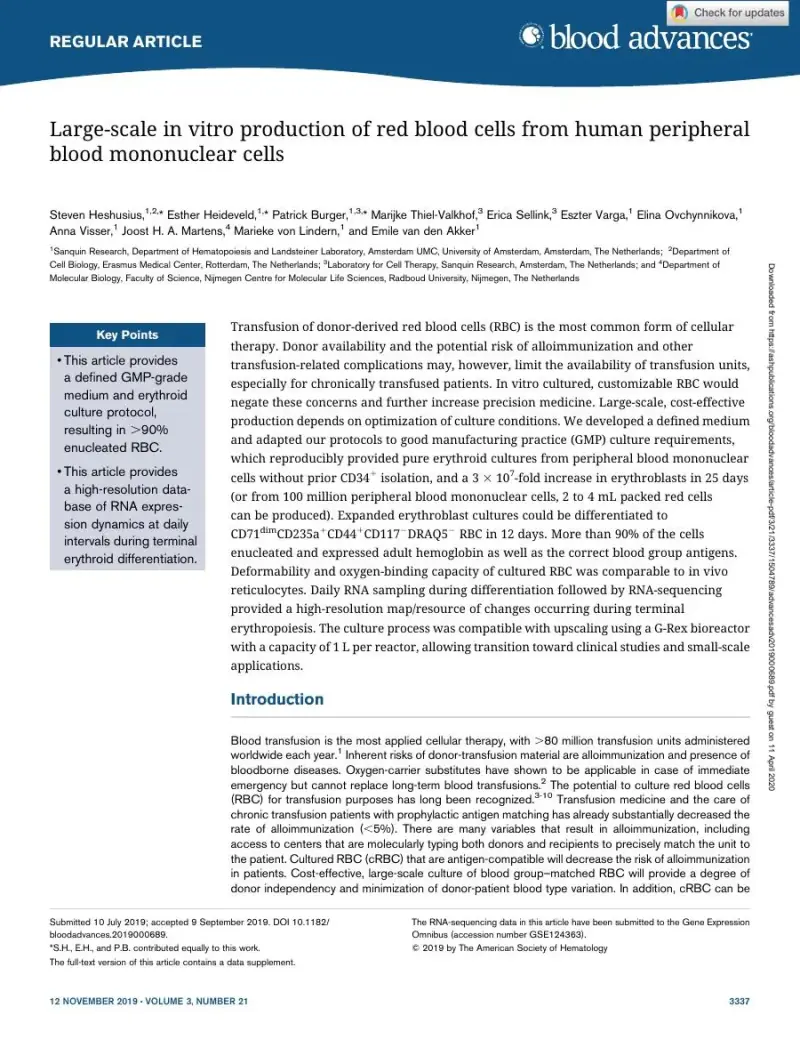
A defined, GMP-grade medium called Cellquin supported pure erythroid cultures from adult peripheral blood mononuclear cells without prior CD34 isolation and gave more than 90% enucleated red blood cells. Erythroblasts expanded about 3 × 10^7-fold in 25 days, and 100 million PBMC can yield 2 to 4 mL of packed red cells. Cultures started in dishes for about 7 days, then expanded in dishes or a G-Rex® bioreactor and differentiated for 12 days, with enucleation above 90% in dishes and almost 85% in G-Rex®. The cultured cells expressed mainly adult hemoglobin, matched donor blood group antigens, and showed deformability comparable to late peripheral blood reticulocytes. Daily RNA-sequencing during differentiation produced a high-resolution transcriptome resource.
Note: In vitro study; the authors note that additional optimization and cost reduction are needed, as well as research into loading and stability of therapeutics within the cultured cells.
The culture process was compatible with up-scaling for clinical studies and applications using a G-Rex bioreactor. — Steven Heshusius, Esther Heideveld, Patrick Burger, Marijke Thiel-Valkhof, Erica Sellink, Eszter Varga, Elina Ovchynnikova, Anna Visser, Joost H. A. Martens, Marieke von Lindern, Emile van den Akker, Blood Advances
Study details
- Authors
- Steven Heshusius, Esther Heideveld, Patrick Burger, Marijke Thiel-Valkhof, Erica Sellink, Eszter Varga, Elina Ovchynnikova, Anna Visser, Joost H. A. Martens, Marieke von Lindern, Emile van den Akker
- Institution
- Sanquin Research, Department of Hematopoiesis and Landsteiner Laboratory, Amsterdam UMC, University of Amsterdam, Amsterdam, The Netherlands · Department of Cell Biology, Erasmus Medical Center, Rotterdam, The Netherlands · Laboratory for Cell Therapy, Sanquin Research, Amsterdam, The Netherlands · Department of Molecular Biology, Faculty of Science, Nijmegen Centre for Molecular Life Sciences, Radboud University, Nijmegen, The Netherlands
- Journal
- Blood Advances
- Year
- 2019
- Cell type(s)
- Other
- Application area
- Other
- Study phase
- Preclinical
How G-Rex® was used
A G-Rex® bioreactor from Wilson Wolf was used for erythroblast expansion and differentiation. PBMC were first cultured in dishes or cell stacks for about 7 days until a pure erythroblast population formed, and the erythroblasts were then transferred to G-Rex®, maintained for at least 26 days, and expanded about 3 × 10^6-fold per PBMC. For differentiation, erythroblasts were reseeded at 1 × 10^6 cells/mL in differentiation medium with EPO, transferrin, 5% plasma and heparin, with only 90% of the expansion medium replaced and storage components added on day 5. After 12 days, almost 85% of cells were enucleated.
Explore related
Full citation
Heshusius S, Heideveld E, Burger P, et al. Large-scale in vitro production of red blood cells from human peripheral blood mononuclear cells. Blood Adv. 2019;3(21):3337-3350.
Building a similar workflow?
Talk to a ScaleReady specialist about how the G-Rex® platform can support your program — from process development to clinical-scale manufacturing.


