
CAR T cell therapy for breast cancer: harnessing the tumor milieu to drive T cell activation
Overview
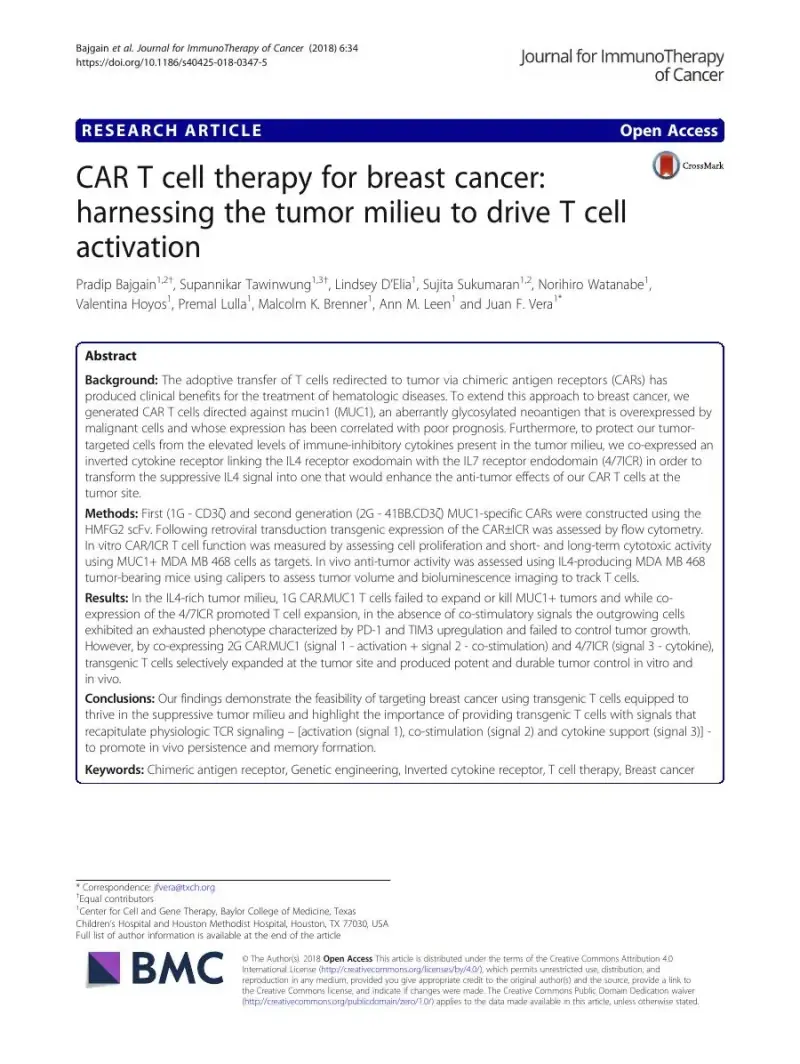
Generated MUC1-specific CAR T cells co-expressing an inverted cytokine receptor (4/7ICR) for breast cancer. Co-culture experiments to monitor anti-tumor activity were conducted in 6-well G-Rex® devices using a 3D algimatrix bioscaffold.
What this paper found
Breast cancer-directed T cells were engineered with a CAR against MUC1 plus an inverted cytokine receptor that converts the immunosuppressive IL4 signal into an IL7-type growth signal. First-generation CAR cells with the receptor expanded in IL4 but became exhausted, with PD-1 and TIM3 upregulation, and did not control tumors. Cells carrying a second-generation 41BB.CD3ζ CAR together with the receptor expanded, kept CD25 expression and sustained killing after 21 days of co-culture. In mice bearing IL4-producing MDA MB 468 tumors, every animal given these cells became tumor-free, and cell numbers fell after clearance. Tumor rechallenge re-expanded the cells only at the IL4-producing site.
Note: The work consists of in vitro and mouse xenograft experiments; the authors state that the results support clinical translation of the approach.
However, while none of the 1G.4/7ICR-treated animals were tumor-free, every mouse receiving 2G.4/7ICR T cells was tumor-free and remained so for an additional 4 weeks. — Pradip Bajgain, Supannikar Tawinwung, Lindsey D’Elia, Sujita Sukumaran, Norihiro Watanabe, Valentina Hoyos, Premal Lulla, Malcolm K. Brenner, Ann M. Leen, Juan F. Vera, Journal for ImmunoTherapy of Cancer
Study details
- Authors
- Pradip Bajgain, Supannikar Tawinwung, Lindsey D’Elia, Sujita Sukumaran, Norihiro Watanabe, Valentina Hoyos, Premal Lulla, Malcolm K. Brenner, Ann M. Leen, Juan F. Vera
- Institution
- Center for Cell and Gene Therapy, Baylor College of Medicine, Texas Children's Hospital and Houston Methodist Hospital, Houston, TX, USA · Interdepartmental Program in Translational Biology and Molecular Medicine, Baylor College of Medicine, Houston, TX, USA · Department of Pharmacology and Physiology, Faculty of Pharmaceutical Sciences, Chulalongkorn University, Bangkok, Thailand
- Journal
- Journal for ImmunoTherapy of Cancer
- Year
- 2018
- G-Rex® model(s)
- G-Rex®6 Well Plate
- Cell type(s)
- CAR T Cells
- Application area
- Solid tumor
- Study phase
- Preclinical
How G-Rex® was used
MUC1-overexpressing eGFP-FFLuc+ MDA MB 468 tumor cells (1 × 10^6) were seeded into a 3D Algimatrix bioscaffold and cultured in 6-well G-Rex® devices. Three days later CAR or CAR+ICR T cells were added at a 1:10 T cell:tumor ratio with 400 U/mL IL4. Tumor killing was followed by bioluminescence imaging for 21 days of co-culture.
Explore related

Full citation
Bajgain P, Tawinwung S, D'Elia L, et al. CAR T cell therapy for breast cancer: harnessing the tumor milieu to drive T cell activation. J Immunother Cancer. 2018;6(1):34.
Building a similar workflow?
Talk to a ScaleReady specialist about how the G-Rex® platform can support your program — from process development to clinical-scale manufacturing.


