
Clinical-Scale Rapid Autologous BK Virus-Specific T Cell Line Generation From Kidney Transplant Recipients With Active Viremia for Adoptive Immunotherapy
Overview
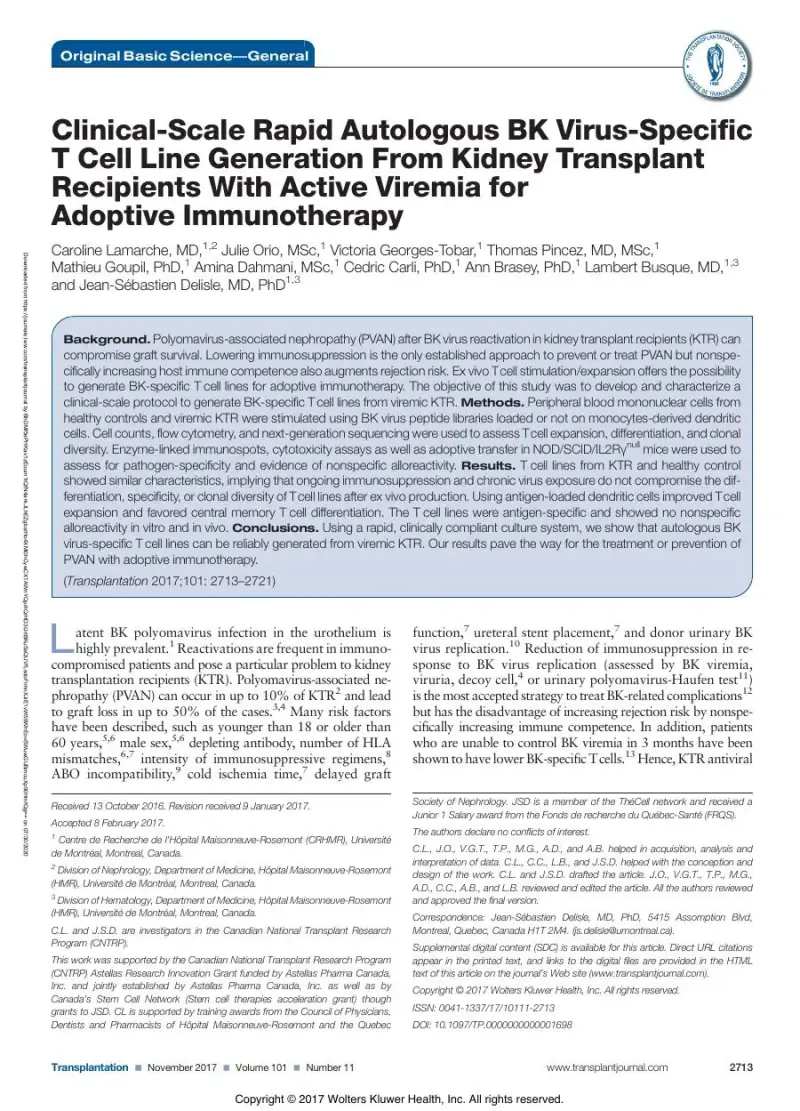
Describes a clinical-scale protocol to generate autologous BK virus-specific T cell lines from kidney transplant recipients. G-Rex®10 vessels were used for all T cell cultures, allowing for rapid expansion and generation of antigen-specific T cell lines suitable for adoptive immunotherapy.
What this paper found
Autologous BK virus-specific T cell lines can be generated at clinical scale in 14 days from kidney transplant recipients with active viremia, but only when peptide-pulsed dendritic cells are used for stimulation. Direct peptide stimulation of PBMC gave fold expansions of 12.1 ± 7.4 in healthy controls and 4.6 ± 1.9 in recipients, and fewer than 50 million cells for 3 of 5 recipient lines. Dendritic cell stimulation significantly increased expansion (P = 0.042), shifted differentiation toward central memory, and improved VP1 specificity. Lines from both groups remained polyclonal, lysed only peptide-loaded autologous targets, and, unlike unmanipulated T cells, caused no xenogeneic graft-versus-host disease in NSG mice while persisting for 11 to 12 weeks.
Note: The authors note that the study was limited by patient numbers and variable culture yields, and that the therapeutic efficacy of the lines could not be evaluated in vivo because no mouse model of BK virus infection exists.
Collectively, this work describes a readily translatable approach to manufacture autologous BK-specific T cell lines from KTR for adoptive immunotherapy. — Caroline Lamarche, Julie Orio, Victoria Georges-Tobar, Thomas Pincez, Mathieu Goupil, Amina Dahmani, Cedric Carli, Ann Brasey, Lambert Busque, Jean-Sébastien Delisle, Transplantation
Study details
- Authors
- Caroline Lamarche, Julie Orio, Victoria Georges-Tobar, Thomas Pincez, Mathieu Goupil, Amina Dahmani, Cedric Carli, Ann Brasey, Lambert Busque, Jean-Sébastien Delisle
- Institution
- Centre de Recherche de l’Hôpital Maisonneuve-Rosemont (CRHMR), Université de Montréal, Montreal, Canada · Division of Nephrology, Department of Medicine, Hôpital Maisonneuve-Rosemont (HMR), Université de Montréal, Montreal, Canada · Division of Hematology, Department of Medicine, Hôpital Maisonneuve-Rosemont (HMR), Université de Montréal, Montreal, Canada
- Journal
- Transplantation
- Year
- 2017
- PMID / PMC
- PMID: 28230645
- G-Rex® model(s)
- G-Rex®10
- Cell type(s)
- VST Cells
- Application area
- Infectious disease
- Study phase
- Preclinical
How G-Rex® was used
T cell lines were grown for 14 days in a GRex10 vessel with 30 mL of T cell medium containing 10% human serum, IL-4 (1666 U/mL) and IL-7 (10 ng/mL), at 37°C and 5% CO2. Cultures were stimulated with 10 to 15 × 10^6 PBMC pulsed with VP1 and LTA peptide libraries, or with PBMC cocultured with peptide-pulsed irradiated autologous dendritic cells at 1:10. Medium and cytokines were changed on days 5, 8 and 12, and cultures were split at days 8 and 12 above 45 × 10^6 cells/mL. Mean expansion was 12.1-fold (healthy controls) and 4.6-fold (recipients) with peptide-pulsed PBMC.
Explore related

Full citation
Lamarche C, Orio J, Georges-Tobar V, et al. Clinical-Scale Rapid Autologous BK Virus-Specific T Cell Line Generation From Kidney Transplant Recipients With Active Viremia for Adoptive Immunotherapy. Transplantation. 2017;101(11):2713-2721.
Building a similar workflow?
Talk to a ScaleReady specialist about how the G-Rex® platform can support your program — from process development to clinical-scale manufacturing.


