
Single-cell profiling of dynamic cytokine secretion and the phenotype of immune cells
Overview
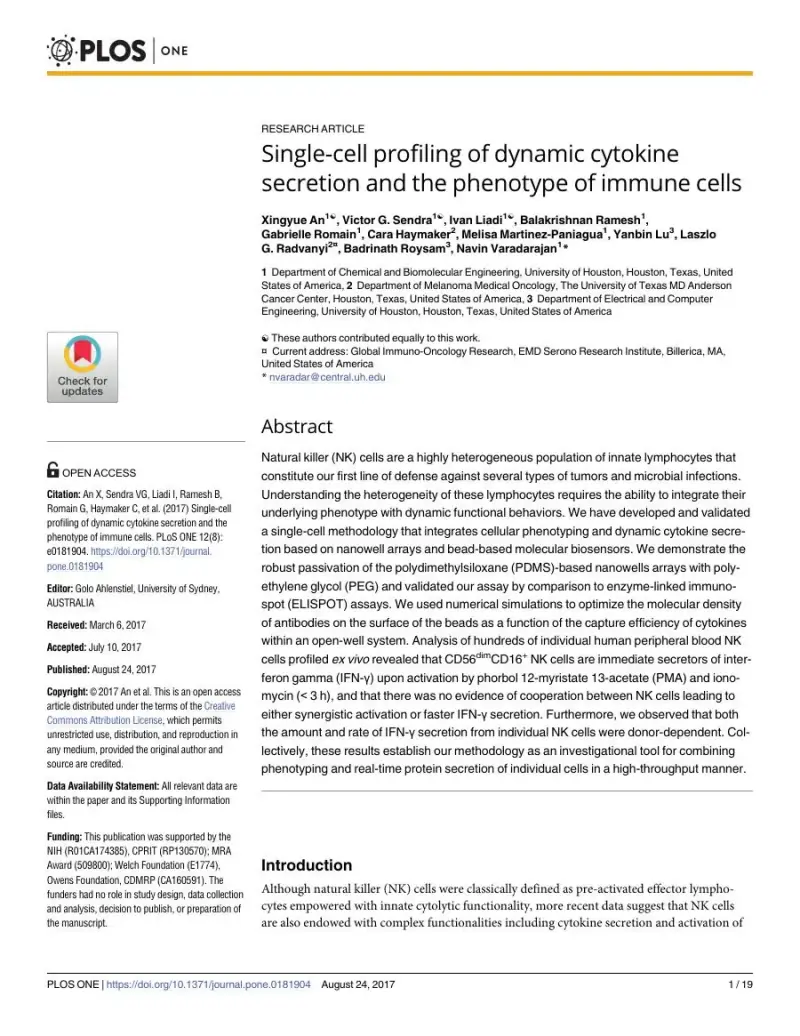
A single-cell methodology integrating cellular phenotyping and dynamic cytokine secretion was developed using nanowell arrays. G-Rex® 100M were used for the rapid expansion protocol (REP) of tumor-infiltrating lymphocytes (TILs) to achieve desired cell numbers for experiments.
What this paper found
A single-cell platform that links cell phenotype with real-time cytokine secretion was built from thin-bottom PDMS nanowell arrays and antibody-coated beads, and it showed that CD16-positive NK cells are rapid interferon gamma secretors. PEG grafting for 20 minutes reduced non-specific binding. Bead-based counts of IFN-γ-secreting T cells (0.40–7.8%) matched ELISPOT (0.20–11.2%), with R2 = 0.87. Simulations indicated that captured cytokine density rose with time over 0–6 h in an open well. In peripheral blood NK cells stimulated with PMA and ionomycin, secretion peaked around 50–60 minutes, and the amount and rate of secretion differed between donors. Pairs or triplets of NK cells showed no synergy.
Note: The method was tested on cells from a limited number of donors and under PMA/ionomycin mitogenic stimulation; the authors note the findings hold at least for this stimulation.
Collectively, these results establish our methodology as an investigational tool for combining phenotyping and real-time protein secretion of individual cells in a high-throughput manner. — Xingyue An, Victor G. Sendra, Ivan Liadi, Balakrishnan Ramesh, Gabrielle Romain, Cara Haymaker, Melisa Martinez-Paniagua, Yanbin Lu, Laszlo G. Radvanyi, Badrinath Roysam, Navin Varadarajan, PLOS ONE
Study details
- Authors
- Xingyue An, Victor G. Sendra, Ivan Liadi, Balakrishnan Ramesh, Gabrielle Romain, Cara Haymaker, Melisa Martinez-Paniagua, Yanbin Lu, Laszlo G. Radvanyi, Badrinath Roysam, Navin Varadarajan
- Institution
- Department of Chemical and Biomolecular Engineering, University of Houston, Houston, Texas, United States of America · Department of Melanoma Medical Oncology, The University of Texas MD Anderson Cancer Center, Houston, Texas, United States of America · Department of Electrical and Computer Engineering, University of Houston, Houston, Texas, United States of America
- Journal
- PLOS ONE
- Year
- 2017
- G-Rex® model(s)
- G-Rex®100M
- Cell type(s)
- NK Cells, TIL Cells
- Application area
- Other
- Study phase
- Preclinical
How G-Rex® was used
Tumor-infiltrating lymphocytes from melanoma patients were expanded in a G-Rex® 100M flask during the rapid expansion protocol. After initial expansion in 24-well plates, the TIL were cultured together with PBMC feeder cells at a ratio of 1 TIL to 200 feeders. The feeders were preloaded with anti-CD3 (OKT3). Cells were cultured until the desired number was reached and then harvested. These expanded TIL were then used in the ELISPOT and bead-based IFN-γ assays.
Explore related

Full citation
An X, Sendra VG, Liadi I, et al. Single-cell profiling of dynamic cytokine secretion and the phenotype of immune cells. PLoS One. 2017;12(8):e0181904.
Building a similar workflow?
Talk to a ScaleReady specialist about how the G-Rex® platform can support your program — from process development to clinical-scale manufacturing.


