
A single exercise bout enhances the manufacture of viral-specific T-cells from healthy donors: implications for allogeneic adoptive transfer immunotherapy
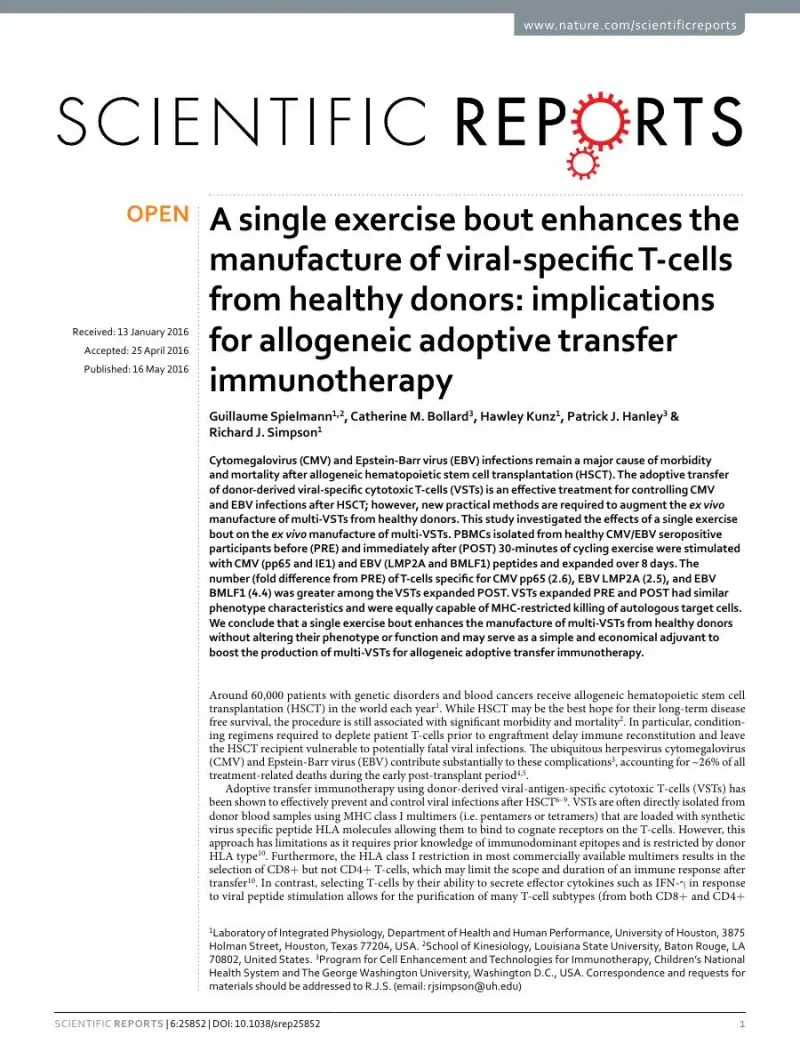
Overview
This study showed that collecting PBMCs after exercise increases the yield of VSTs. The VSTs were expanded in G-Rex®10 for 8 days, demonstrating that exercise is a simple adjuvant for improving VST manufacture.
What this paper found
A single 30-minute bout of cycling before blood collection increased how many CMV- and EBV-specific T-cells could be manufactured from healthy seropositive donors' blood in 8 days. Peripheral blood mononuclear cells (10 × 10^6) from nine seropositive donors, drawn before or immediately after exercise, were pulsed with CMV pp65 and IE1 and EBV LMP2A and BMLF1 peptides and cultured in gas-permeable flasks. Post-exercise cultures contained 2.6-fold more pp65-specific, 2.5-fold more LMP2A-specific and 4.4-fold more BMLF1-specific T-cells than pre-exercise cultures; IE1 did not differ significantly. Fold differences were adjusted for total T-cells recovered at day 8. Phenotype and MHC-restricted killing of autologous peptide-pulsed targets were similar. No VSTs expanded from a seronegative donor.
Note: The authors note that the minimum exercise intensity and duration required, and the effect in donors with below-average fitness, remain to be determined.
The VSTs produced after exercise were equally effective at killing autologous peptide-pulsed target cells, and had similar phenotype characteristics to those T-cell lines produced from the same donors at rest. — Guillaume Spielmann, Catherine M. Bollard, Hawley Kunz, Patrick J. Hanley, Richard J. Simpson, Scientific Reports
Study details
- Authors
- Guillaume Spielmann, Catherine M. Bollard, Hawley Kunz, Patrick J. Hanley, Richard J. Simpson
- Institution
- Laboratory of Integrated Physiology, Department of Health and Human Performance, University of Houston, Houston, Texas, USA · School of Kinesiology, Louisiana State University, Baton Rouge, Louisiana, USA · Program for Cell Enhancement and Technologies for Immunotherapy, Children's National Health System and The George Washington University, Washington D.C., USA
- Journal
- Scientific Reports
- Year
- 2016
- G-Rex® model(s)
- G-Rex®10
- Cell type(s)
- VST Cells
- Application area
- Infectious disease
- Study phase
- Preclinical
How G-Rex® was used
PBMCs (10 × 10^6) collected before or after exercise were pulsed with CMV and EBV peptide libraries for 60 minutes, then resuspended in 10 mL of RPMI 1640 with 10% FBS, IL-7 (10 ng/mL) and IL-4 (1,666 IU/mL). The cells were transferred to a G-Rex®10 gas-permeable flask and cultured for 8 days at 37 °C. Medium and cytokines were replenished at day 5 with fresh RPMI 1640, 10% FBS, IL-7, IL-4 and IL-15 (5 ng/mL). Post-exercise cultures yielded 2.6-, 2.5- and 4.4-fold more pp65-, LMP2A- and BMLF1-specific T-cells than pre-exercise cultures.
Explore related

Full citation
Spielmann G, Bollard CM, Kunz H, Hanley PJ, Simpson RJ. A single exercise bout enhances the manufacture of viral-specific T-cells from healthy donors: implications for allogeneic adoptive transfer immunotherapy. Sci Rep. 2016;6:25852.
Building a similar workflow?
Talk to a ScaleReady specialist about how the G-Rex® platform can support your program — from process development to clinical-scale manufacturing.


