
Plasticity and Aggregation of Juvenile Porcine Islets in Modified Culture: Preliminary Observations
Overview
The study reports that culturing juvenile porcine islets in Wilson Wolf gas-permeable (G-Rex®) allows them to aggregate into functional 'pancreatites'. These flasks were also used for shipping the islets, maintaining viability and function.
What this paper found
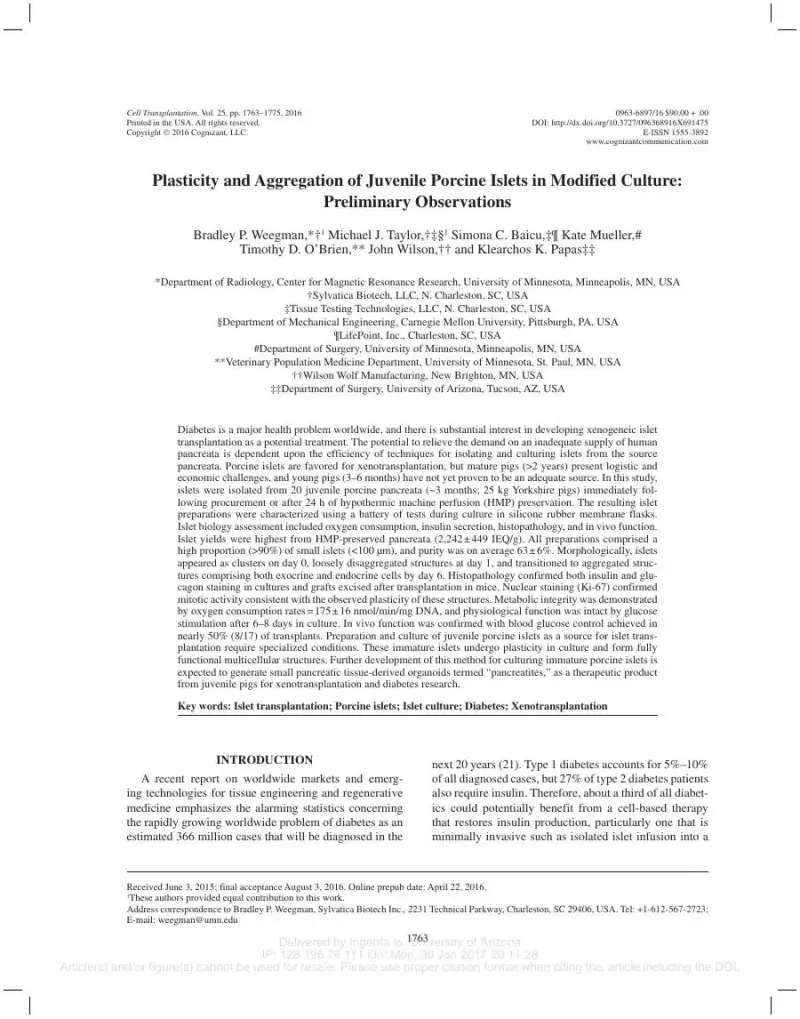
Juvenile porcine islets, normally too fragile to culture, survived a week in gas-permeable silicone rubber membrane flasks and reorganized into larger aggregates of endocrine and exocrine cells that the authors call pancreatites. Islets were isolated from 20 pancreata of about 3-month-old pigs, either fresh or after 24 h of hypothermic machine perfusion, with the highest yield, 2,242 ± 449 IEQ/g, from perfused organs. More than 90% of islets were under 100 μm at isolation. Oxygen consumption was 175 ± 16 nmol/min/mg DNA after overnight shipment, and glucose-stimulated insulin secretion remained intact. Ki-67 staining showed mitotic activity in culture and in grafts. In diabetic nude mice, 8 of 17 recipients (47%) reached glycemic control, on average 25 days after transplantation.
Note: Preliminary study with a limited number of nude mouse transplants; the authors note that dose titration and longer follow-up are needed.
We conclude from these preliminary observations that immature islets isolated from juvenile porcine pancreata form cellular aggregates comprising both exocrine and endocrine cells in modified tissue culture. — Bradley P. Weegman, Michael J. Taylor, Simona C. Baicu, Kate Mueller, Timothy D. O'brien, John Wilson, Klearchos K. Papas, Cell Transplantation
Study details
- Authors
- Bradley P. Weegman, Michael J. Taylor, Simona C. Baicu, Kate Mueller, Timothy D. O'brien, John Wilson, Klearchos K. Papas
- Institution
- Department of Radiology, Center for Magnetic Resonance Research, University of Minnesota, Minneapolis, MN, USA · Sylvatica Biotech, LLC, N. Charleston, SC, USA · Tissue Testing Technologies, LLC, N. Charleston, SC, USA · Department of Mechanical Engineering, Carnegie Mellon University, Pittsburgh, PA, USA · LifePoint, Inc., Charleston, SC, USA · Department of Surgery, University of Minnesota, Minneapolis, MN, USA · Veterinary Population Medicine Department, University of Minnesota, St. Paul, MN, USA · Wilson Wolf Manufacturing, New Brighton, MN, USA · Department of Surgery, University of Arizona, Tucson, AZ, USA
- Journal
- Cell Transplantation
- Year
- 2016
- PMID / PMC
- PMID: 27109912
- Cell type(s)
- Other
- Application area
- Other
- Study phase
- Preclinical
How G-Rex® was used
Juvenile porcine islets were cultured for up to 7 days at 37°C in Wilson Wolf silicone rubber membrane gas-permeable flasks, in ME199 medium modified with Trolox, the antiapoptotic agent Q-VD-OPH and 10% porcine serum. Culture followed islet isolation from fresh or 24-h perfused pancreata and Optiprep purification. Islets were monitored daily by dithizone-stained phase contrast microscopy, and over the week they aggregated into larger structures; end-culture recovery was about 72–76% of day 0 islets. The shipping version of the Wilson Wolf flask carried the aggregates overnight to Minnesota and Yale, where they stayed intact and functional.
Explore related
Full citation
Weegman BP, Taylor MJ, Baicu SC, et al. Plasticity and Aggregation of Juvenile Porcine Islets in Modified Culture: Preliminary Observations. Cell Transplant. 2016;25(10):1763-1775.
Building a similar workflow?
Talk to a ScaleReady specialist about how the G-Rex® platform can support your program — from process development to clinical-scale manufacturing.


