
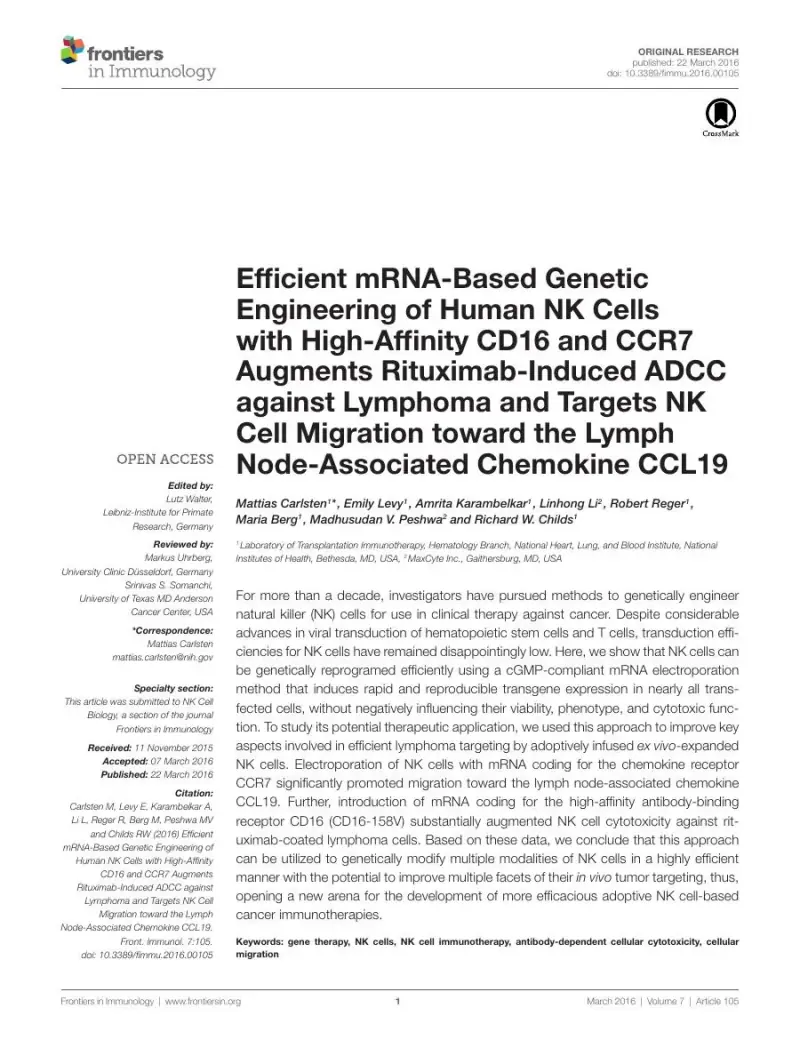
Efficient mRNA-Based Genetic Engineering of Human NK Cells with High-Affinity CD16 and CCR7 Augments Rituximab-Induced ADCC against Lymphoma and Targets NK Cell Migration toward the Lymph Node-Associated Chemokine CCL19
Overview
This study shows efficient mRNA electroporation of NK cells. Clinical-grade NK cells were expanded ex vivo using G-Rex® prior to electroporation, allowing for the generation of large numbers of highly cytotoxic cells.
What this paper found
Ex vivo-expanded human NK cells can be genetically reprogrammed with a cGMP-compliant mRNA electroporation platform that gives rapid transgene expression in nearly all cells without harming viability or cytotoxicity. Electroporation with eGFP mRNA produced expression in nearly 100% of cells, with more than 95% positive for the first 7 to 9 days. Cells loaded with CCR7 mRNA, at 4 µg per million cells, showed dose-dependent migration toward the lymph node chemokine CCL19, whereas non-electroporated cells did not. Introducing mRNA for high-affinity CD16-158V into cells from CD16-158F/F donors raised CD16 expression and increased rituximab-dependent degranulation and killing of CD20-positive lymphoma cells for up to 3 days. Phenotype changes were minor.
Note: Preclinical in vitro study; the authors note that future clinical trials will be needed to establish the potential of this approach in patients with cancer.
Collectively, our data demonstrate that mRNA electroporation is an efficient method to genetically modify NK cells, with the potential to reprogram multiple NK cell properties that boost their antitumor function without incurring any major negative effects on this cell population. — Mattias Carlsten, Emily Levy, Amrita Karambelkar, Linhong Li, Robert Reger, Maria Berg, Madhusudan V. Peshwa, Richard W. Childs, Frontiers in Immunology
Study details
- Authors
- Mattias Carlsten, Emily Levy, Amrita Karambelkar, Linhong Li, Robert Reger, Maria Berg, Madhusudan V. Peshwa, Richard W. Childs
- Institution
- Laboratory of Transplantation Immunotherapy, Hematology Branch, National Heart, Lung, and Blood Institute, National Institutes of Health, Bethesda, MD, USA · MaxCyte Inc., Gaithersburg, MD, USA
- Journal
- Frontiers in Immunology
- Year
- 2016
- Cell type(s)
- NK Cells
- Application area
- Hematologic malignancy
- Study phase
- Preclinical
How G-Rex® was used
Healthy-donor NK cells, isolated from PBMC with a Miltenyi kit, were expanded in G-Rex® flasks together with irradiated EBV-SMI-LCL feeder cells at a 1:10 ratio. The medium was X-VIVO 20 with 10% heat-inactivated human AB plasma and 500 IU/ml recombinant human IL-2. Cultures were kept at 37°C and 6.5% CO2, half of the medium was replaced on day 5, and from day 7 cells were counted and adjusted to 0.5–1 × 10^6 cells/ml every 48 h. Expanded cells (11–15 days) were then used for mRNA electroporation experiments.
Note: The expansion method follows the authors' ongoing phase I clinical trial of autologous NK cell infusion.
Explore related
Full citation
Carlsten M, Levy E, Karambelkar A, et al. Efficient mRNA-Based Genetic Engineering of Human NK Cells with High-Affinity CD16 and CCR7 Augments Rituximab-Induced ADCC against Lymphoma and Targets NK Cell Migration toward the Lymph Node-Associated Chemokine CCL19. Front Immunol. 2016;7:105.
Building a similar workflow?
Talk to a ScaleReady specialist about how the G-Rex® platform can support your program — from process development to clinical-scale manufacturing.


