
Early transduction produces highly functional chimeric antigen receptor-modified virus-specific T-cells with central memory markers: a Production Assistant for Cell Therapy (PACT) translational application
Overview
The authors developed a method for early transduction of trivirus-specific T cells. The clinical SOP utilized G-Rex®100 for the second stimulation phase to rapidly expand transduced VSTs to clinically relevant numbers.
What this paper found
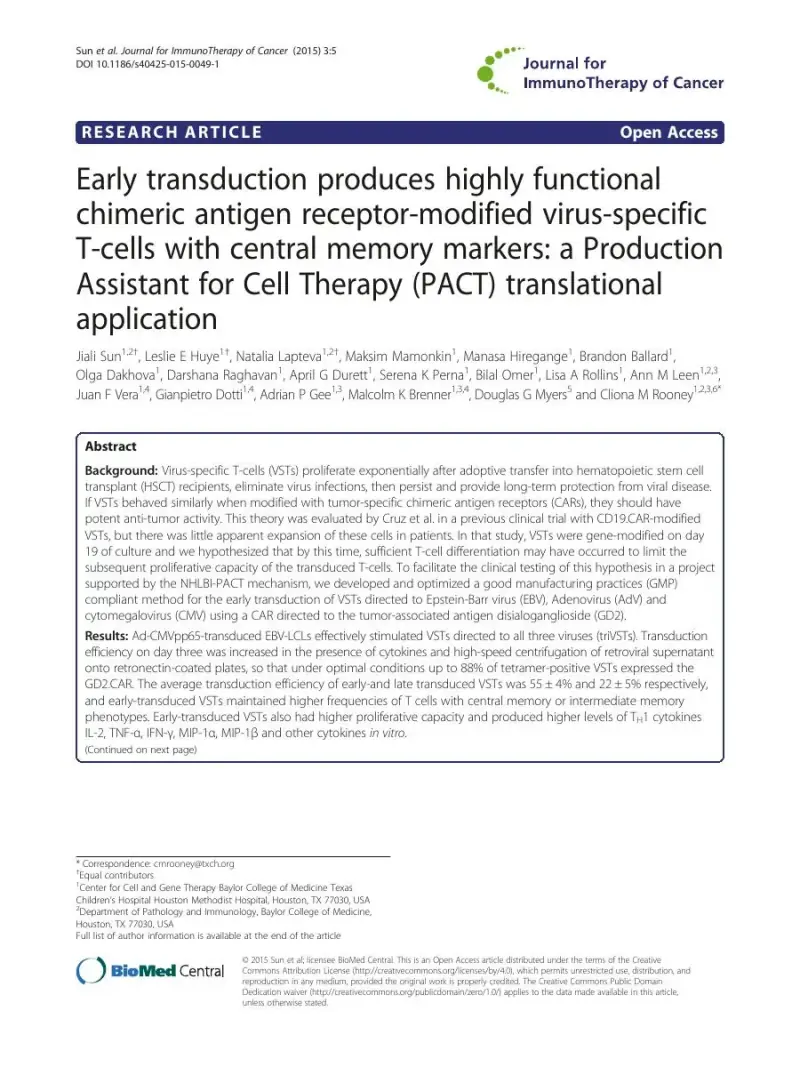
Transducing multivirus-specific T cells (EBV, CMV, adenovirus) with a GD2-directed CAR on day 3 of culture, after only one stimulation, gave higher and more stable transgene expression than the previous day-19 approach. Early transduction reached a mean of 55% CAR-positive cells, versus 22% for late transduction, and the product held a higher share of central memory cells in 5 of 6 donors, with greater proliferation and higher TH1 cytokine output. Centrifuging retroviral supernatant onto retronectin-coated plates increased efficiency, and IL-4 and IL-7 improved expansion. In GMP validation runs, triVSTs expanded 5.4-fold after the first stimulation and 178-fold after the second, transgene expression rose from 61% to 78%, and viability at cryopreservation was 97.7%.
Note: Preclinical manufacturing study; the authors state that the clinical value of these improvements will be determined only by monitoring patients in the clinical trial.
Perhaps the most important outcome of the optimization study was the transduction of VSTs with a central memory phenotype. — Jiali Sun, Leslie E Huye, Natalia Lapteva, Maksim Mamonkin, Manasa Hiregange, Brandon Ballard, Olga Dakhova, Darshana Raghavan, April G Durett, Serena K Perna, Bilal Omer, Lisa A Rollins, Ann M Leen, Juan F Vera, Gianpietro Dotti, Adrian P Gee, Malcolm K Brenner, Douglas G Myers, Cliona M Rooney, Journal for ImmunoTherapy of Cancer
Study details
- Authors
- Jiali Sun, Leslie E Huye, Natalia Lapteva, Maksim Mamonkin, Manasa Hiregange, Brandon Ballard, Olga Dakhova, Darshana Raghavan, April G Durett, Serena K Perna, Bilal Omer, Lisa A Rollins, Ann M Leen, Juan F Vera, Gianpietro Dotti, Adrian P Gee, Malcolm K Brenner, Douglas G Myers, Cliona M Rooney
- Institution
- Center for Cell and Gene Therapy, Baylor College of Medicine, Texas Children's Hospital, Houston Methodist Hospital, Houston, TX, USA · Department of Pathology and Immunology, Baylor College of Medicine, Houston, TX, USA · Department of Pediatrics, Baylor College of Medicine, Houston, TX, USA · Department of Medicine, Baylor College of Medicine, Houston, TX, USA · Children's Mercy Hospitals and Clinics, Kansas City, MO, USA · Department of Molecular Virology and Immunology, Baylor College of Medicine, Houston, TX, USA
- Journal
- Journal for ImmunoTherapy of Cancer
- Year
- 2015
- G-Rex® model(s)
- G-Rex®100
- Cell type(s)
- CAR T Cells, VST Cells
- Application area
- Infectious disease · Solid tumor
- Study phase
- Preclinical
How G-Rex® was used
After a first stimulation in 24-well plates, GD2.CAR-transduced triVSTs were harvested on day 9 and restimulated with irradiated Ad5f35-pp65-transduced LCLs at a 1:5 T cell to LCL ratio in a G-Rex®100 gas-permeable flask. IL-4 and IL-7 were added at the second stimulation, and IL-2 at 50 U/mL was added every 3 to 4 days from day 12. Later stimulations on days 16 and 23 were also done in the G-Rex®100. In validation runs the second stimulation expanded triVSTs 178 ± 110-fold, from 2 × 10^6 on day 8 to 231 × 10^6 on day 16, and cells were cryopreserved on day 16 to 18.
Explore related

Full citation
Sun J, Huye LE, Lapteva N, et al. Early transduction produces highly functional chimeric antigen receptor-modified virus-specific T-cells with central memory markers: a Production Assistant for Cell Therapy (PACT) translational application. J Immunother Cancer. 2015;3:5.
Building a similar workflow?
Talk to a ScaleReady specialist about how the G-Rex® platform can support your program — from process development to clinical-scale manufacturing.


