
Effector CD8+ T cell engraftment and anti-tumor immunity in lymphodepleted hosts is IL-7Rα dependent
Overview
The study found that IL-12 conditioning increases IL-7Rα, crucial for T cell persistence. For clinical translation, TCR-transduced human T cells were expanded using a rapid expansion protocol in G-Rex® 100 to generate large numbers of cells for analysis.
What this paper found
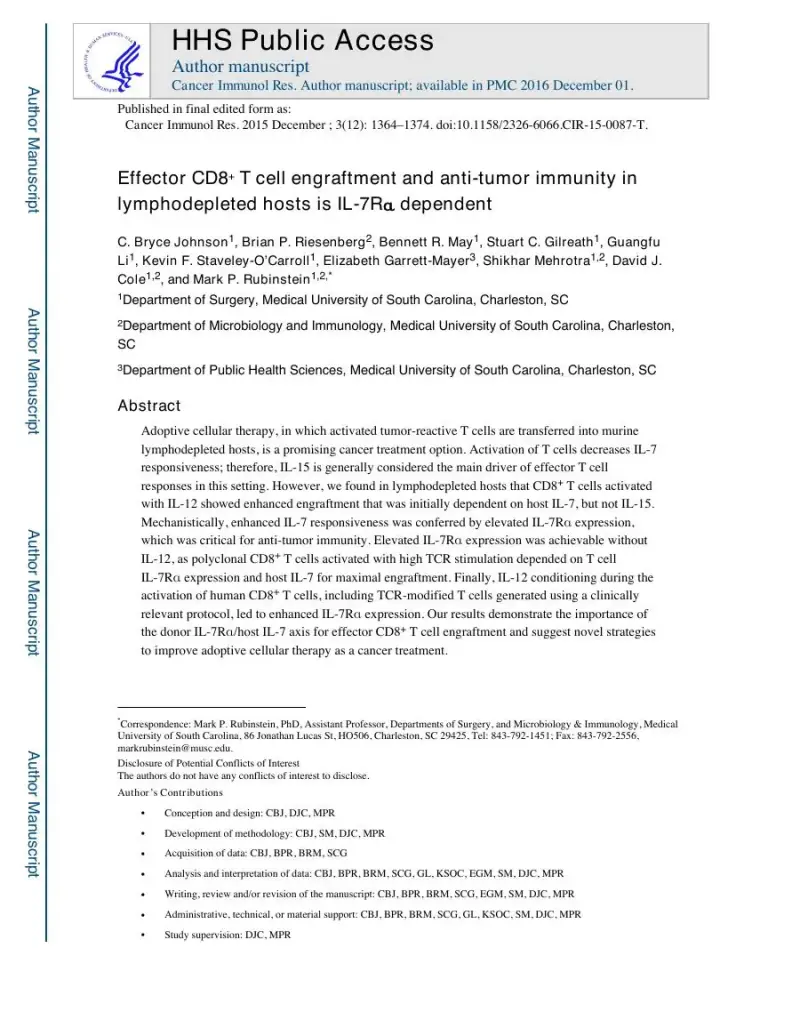
Effector CD8+ T cells transferred into lymphodepleted mice depend on host IL-7, not IL-15, for initial engraftment, and this depends on elevated IL-7Rα expression on the donor cells. In irradiated mice, pmel-1 T cells activated with IL-12 (Tc1) expanded strongly, and IL-7 neutralization reduced their numbers at day 7 while IL-15 knockout did not. Tc1 cells from IL-7Rα heterozygous mice, with about half the receptor level, gave about half as many spleen donor cells and weaker antitumor activity against B16 melanoma. Strong TCR stimulation raised IL-7Rα without IL-12, and IL-12 during activation of human CD8+ T cells, including TCR-transduced cells, enhanced IL-7Rα expression after reculture. Host IL-15 was still needed for maximal antitumor efficacy and long-term persistence.
Note: Mouse experiments used pmel-1 TCR transgenic CD8+ T cells and B16 melanoma; the human work was in vitro with cells from healthy donors, and the authors note that the IL-15 dependence of host cells may also be relevant for long-term efficacy.
In practical terms, our results demonstrate that a direct and feasible way to produce IL-7R α expressing, IL-7 responsive effector T cells is ex vivo IL-12 conditioning. — C. Bryce Johnson, Brian P. Riesenberg, Bennett R. May, Stuart C. Gilreath, Guangfu Li, Kevin F. Staveley-O'Carroll, Elizabeth Garrett-Mayer, Shikhar Mehrotra, David J. Cole, Mark P. Rubinstein, Cancer Immunology Research
Study details
- Authors
- C. Bryce Johnson, Brian P. Riesenberg, Bennett R. May, Stuart C. Gilreath, Guangfu Li, Kevin F. Staveley-O'Carroll, Elizabeth Garrett-Mayer, Shikhar Mehrotra, David J. Cole, Mark P. Rubinstein
- Institution
- Department of Surgery, Medical University of South Carolina, Charleston, SC, USA · Department of Microbiology and Immunology, Medical University of South Carolina, Charleston, SC, USA · Department of Public Health Sciences, Medical University of South Carolina, Charleston, SC, USA
- Journal
- Cancer Immunology Research
- Year
- 2015
- G-Rex® model(s)
- G-Rex®100
- Cell type(s)
- TCR T Cells
- Application area
- Solid tumor
- Study phase
- Preclinical
How G-Rex® was used
Human TCR-modified T cells were produced from PBMCs with soluble anti-CD3, retroviral transduction and cytokine culture. On day 8 they underwent a rapid expansion protocol in a G-Rex® 100 flask, in which 1×10^6 transduced T cells were cultured with 2×10^8 irradiated (50 Gy) allogeneic feeder cells from human donors and soluble anti-CD3 (OKT3, 30 ng/ml). IL-12 was either added or withheld during this expansion. On REP day 14 the cultures were harvested, washed and replated for IL-7Rα analysis 3 days later.
Explore related

Full citation
Johnson CB, Riesenberg BP, May BR, et al. Effector CD8+ T-cell Engraftment and anti-tumor Immunity in Lymphodepleted Hosts Is IL7Rα Dependent. Cancer Immunol Res. 2015;3(12):1364-1374.
Building a similar workflow?
Talk to a ScaleReady specialist about how the G-Rex® platform can support your program — from process development to clinical-scale manufacturing.


