Therapeutic bispecific T-cell engager antibody targeting the intracellular oncoprotein WT1
Overview
This study describes a BiTE derived from a TCR-mimic antibody against WT1. It induced T-cell cytotoxicity against WT1+ tumors and epitope spreading. Transduced EBV-specific T lymphocytes used in in vivo tracking studies were cultured in G-Rex®.
What this paper found
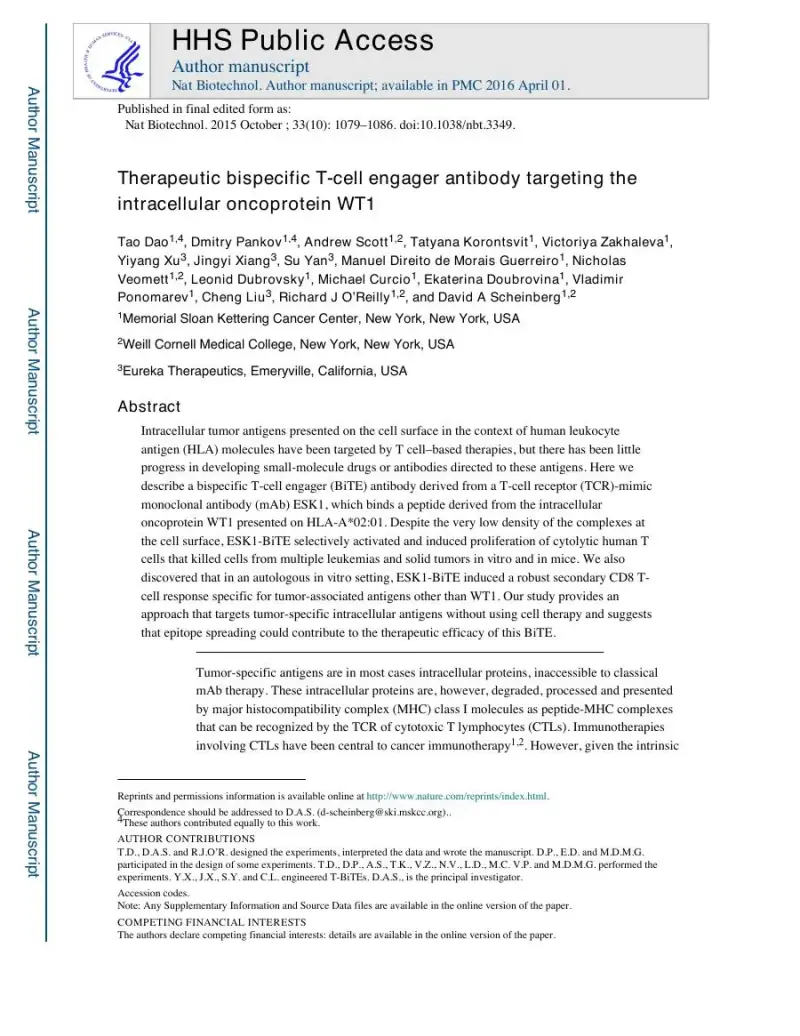
A bispecific T-cell engager built from the TCR-mimic antibody ESK1 can direct T cells against the intracellular oncoprotein WT1 presented on HLA-A*02:01, even though few peptide-HLA complexes sit on the cell surface. ESK1-BiTE triggered dose-dependent T-cell activation and killing of WT1-positive SET-2 AML and BV173 ALL cells in chromium-release assays, with activity down to 1 ng/ml at a 1:1 effector-to-target ratio. In NSG mice with EBV-specific T cells, it suppressed SET-2 leukemia, primary ALL and JMN mesothelioma, and about threefold more T cells accumulated in liver, spleen and bone marrow. In cells from ovarian cancer patients, it also induced a secondary CD8 T-cell response to HER2/Neu, suggesting epitope spreading. T cells activated this way kept growing for 2 months in low-dose IL-15 and IL-2.
Note: The authors note that the epitope-spreading effect has not yet been confirmed in vivo, because no non-human model could accomplish this.
Our study provides an approach that targets tumor-specific intracellular antigens without using cell therapy and suggests that epitope spreading could contribute to the therapeutic efficacy of this BiTE. — Tao Dao, Dmitry Pankov, Andrew Scott, Tatyana Korontsvit, Victoriya Zakhaleva, Yiyang Xu, Jingyi Xiang, Su Yan, Manuel Direito de Morais Guerreiro, Nicholas Veomett, Leonid Dubrovsky, Michael Curcio, Ekaterina Doubrovina, Vladimir Ponomarev, Cheng Liu, Richard J O'Reilly, David A Scheinberg, Nature Biotechnology
Study details
- Authors
- Tao Dao, Dmitry Pankov, Andrew Scott, Tatyana Korontsvit, Victoriya Zakhaleva, Yiyang Xu, Jingyi Xiang, Su Yan, Manuel Direito de Morais Guerreiro, Nicholas Veomett, Leonid Dubrovsky, Michael Curcio, Ekaterina Doubrovina, Vladimir Ponomarev, Cheng Liu, Richard J O'Reilly, David A Scheinberg
- Institution
- Memorial Sloan Kettering Cancer Center, New York, New York, USA · Weill Cornell Medical College, New York, New York, USA · Eureka Therapeutics, Emeryville, California, USA
- Journal
- Nature Biotechnology
- Year
- 2015
- Cell type(s)
- T-Cells, VST Cells
- Application area
- Hematologic malignancy · Solid tumor
- Study phase
- Preclinical
How G-Rex® was used
Transduced EBV-specific T lymphocytes were cultured in a G-Rex® flask from Wilson Wolf Manufacturing Corporation. The cells were first generated from PBMCs by stimulation with irradiated autologous EBV-transformed B cells at a 20:1 responder-to-stimulator ratio in Yssel's medium with 5% human serum, with IL-2 at 10 to 30 units/mL added every 2 to 3 days from day 7 and weekly restimulation at 4:1. They were transduced with a retroviral renilla luciferase vector and sorted by PE. The resulting cells served as effectors in NSG mouse xenograft models, including a T-cell tracing study in which ten million cells were injected.
Explore related
Full citation
Dao T, Pankov D, Scott A, et al. Therapeutic bispecific T-cell engager antibody targeting the intracellular oncoprotein WT1. Nat Biotechnol. 2015;33(10):1079-1086.
Building a similar workflow?
Talk to a ScaleReady specialist about how the G-Rex® platform can support your program — from process development to clinical-scale manufacturing.