
Kinetics of Tumor Destruction by Chimeric Antigen Receptor-modified T Cells
Overview
This research investigates the kinetics of tumor destruction by CAR T cells targeting MUC1 and PSCA. G-Rex® 100M devices were used to expand the CAR-modified T cells. The study found that dual targeting improved efficacy but antigen intensity influenced killing; epigenetic modulation enhanced tumor susceptibility.
What this paper found
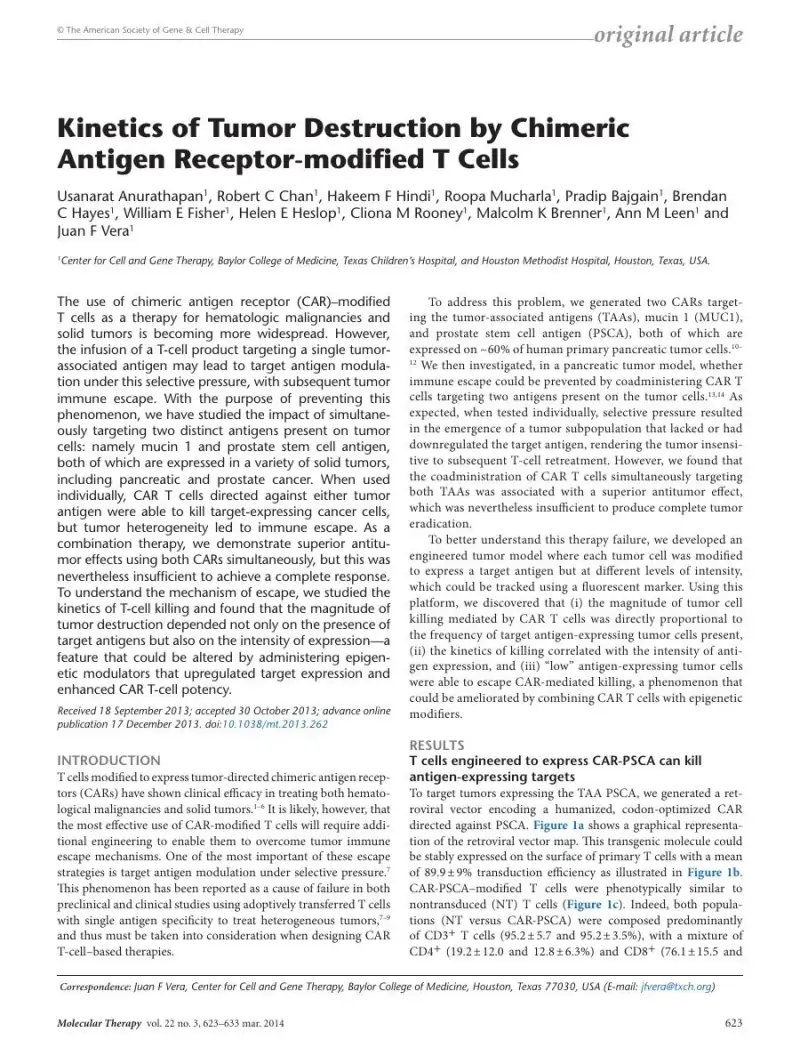
Targeting two tumor antigens at once improves CAR T-cell killing of pancreatic cancer cells but still does not eradicate them, because cells with low antigen density escape. T cells carrying CARs against PSCA or MUC1 killed CAPAN1 cells, yet tumors regrew in mice. In a 72-hour coculture, the combination reduced tumor cells by 96.6%, against 65% for CAR-MUC1 and 82.1% for CAR-PSCA, but tumor recurred in all mice by day 63. In engineered 293T mixtures, cells with the highest antigen levels were killed first and low expressers survived. Decitabine raised MUC1 expression and resensitized resistant tumor cells to CAR-MUC1 T cells.
Note: Preclinical study in cell lines and immunodeficient mice; the authors state that additional preclinical and clinical studies are required to confirm the findings.
Thus, sensitivity to CAR T-cell treatment is related to both the proportion of cells expressing the targeted antigen and the intensity at which the antigen is expressed. — Usanarat Anurathapan, Robert C Chan, Hakeem F Hindi, Roopa Mucharla, Pradip Bajgain, Brendan C Hayes, William E Fisher, Helen E Heslop, Cliona M Rooney, Malcolm K Brenner, Ann M Leen, Juan F Vera, Molecular Therapy
Study details
- Authors
- Usanarat Anurathapan, Robert C Chan, Hakeem F Hindi, Roopa Mucharla, Pradip Bajgain, Brendan C Hayes, William E Fisher, Helen E Heslop, Cliona M Rooney, Malcolm K Brenner, Ann M Leen, Juan F Vera
- Institution
- Center for Cell and Gene Therapy, Baylor College of Medicine, Texas Children's Hospital, and Houston Methodist Hospital, Houston, Texas, USA
- Journal
- Molecular Therapy
- Year
- 2013
- G-Rex® model(s)
- G-Rex®100M
- Cell type(s)
- CAR T Cells
- Application area
- Solid tumor
- Study phase
- Preclinical
How G-Rex® was used
CAR-MUC1 and CAR-PSCA T cells were expanded in a G-Rex® 100M after activation with OKT3/CD28 and retroviral transduction. Transduction used retronectin-coated 24-well plates with activated T cells at 0.2 × 10^6 cells/ml in medium containing IL-2 at 100 U/ml. Expansion in the G-Rex® 100M was performed in 1 l of complete medium supplemented with IL-2 at 50 U/ml. The expanded CAR T cells were then used in cytotoxicity assays, cocultures and mouse experiments.
Note: Cells were phenotyped 3-4 weeks after culture generation.
Explore related

Full citation
Anurathapan U, Chan RC, Hindi HF, et al. Kinetics of Tumor Destruction by Chimeric Antigen Receptor-modified T Cells. Mol Ther. 2014;22(3):623-633.
Building a similar workflow?
Talk to a ScaleReady specialist about how the G-Rex® platform can support your program — from process development to clinical-scale manufacturing.


