
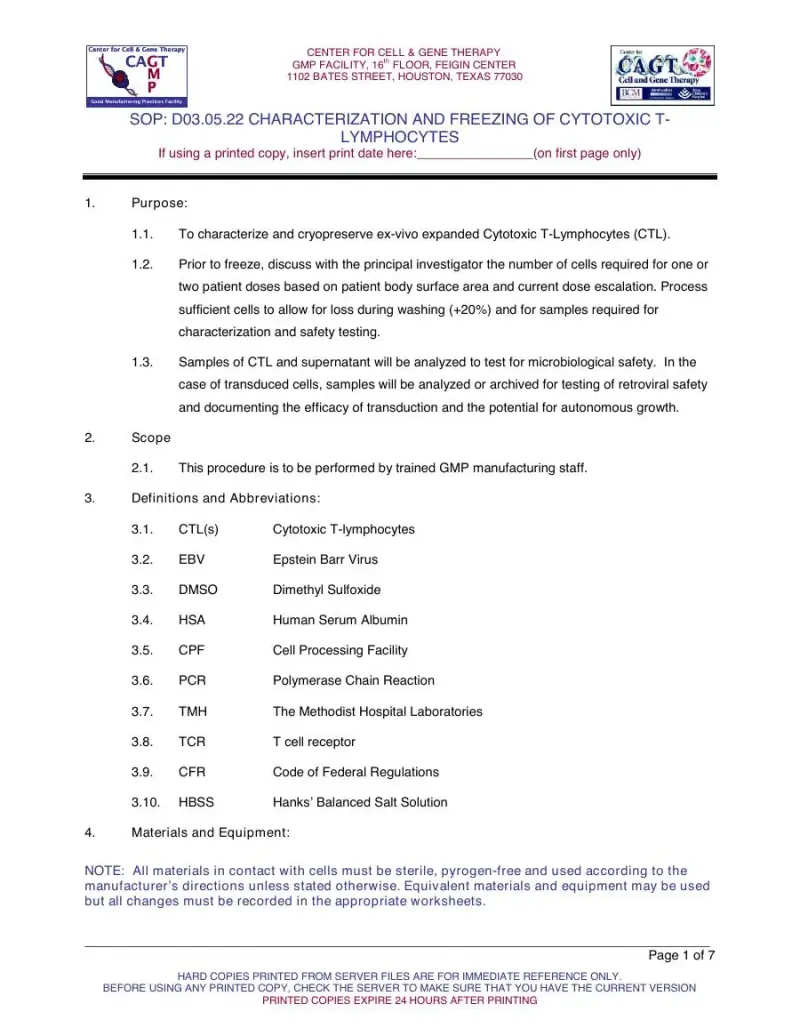
SOP: D03.05.22 CHARACTERIZATION AND FREEZING OF CYTOTOXIC T-LYMPHOCYTES
Overview
SOP for freezing CTLs. Mentions harvesting CTLs from 'wells or GRex '. Provides a protocol for ensuring cell quality and viability during cryopreservation
What this paper found
This GMP standard operating procedure describes how ex vivo expanded cytotoxic T lymphocytes are harvested, characterized, sampled for safety testing and cryopreserved for patient dosing. Cells are harvested from wells or GRex flasks, counted, and aliquots are reserved for mycoplasma PCR, HLA typing, phenotyping and cytotoxicity. The remaining cells are washed four times at 400 × g in HBSS with 10% HSA, then resuspended in ice-cold freezing medium of 10% DMSO, 50% HSA and 40% HBSS at up to 10^7 cells/ml. They are frozen in a controlled-rate freezer and stored in liquid nitrogen. Release requires viability of at least 70%, negative bacterial, fungal and mycoplasma tests, endotoxin below the set limit, and HLA Class I identity with the donor.
Process sufficient cells to allow for loss during washing (+20%) and for samples required for characterization and safety testing. — Cliona Rooney, Catherine Bollard, Helen Heslop, Adrian Gee
Study details
- Authors
- Cliona Rooney, Catherine Bollard, Helen Heslop, Adrian Gee
- Institution
- Center for Cell & Gene Therapy, GMP Facility, Feigin Center, Houston, Texas, USA
- Year
- 2010
- Cell type(s)
- CTL Cells
How G-Rex® was used
Cytotoxic T lymphocytes are harvested from wells or GRex flasks at the end of ex vivo expansion and pooled into a sterile container. The pooled cells are then counted with viability recorded, and aliquots are set aside for quality control before washing and cryopreservation. The procedure gives no flask model, seeding density, medium volume or culture duration for the GRex step.
Building a similar workflow?
Talk to a ScaleReady specialist about how the G-Rex® platform can support your program — from process development to clinical-scale manufacturing.


