
Large-scale ex vivo expansion and characterization of natural killer cells for clinical applications
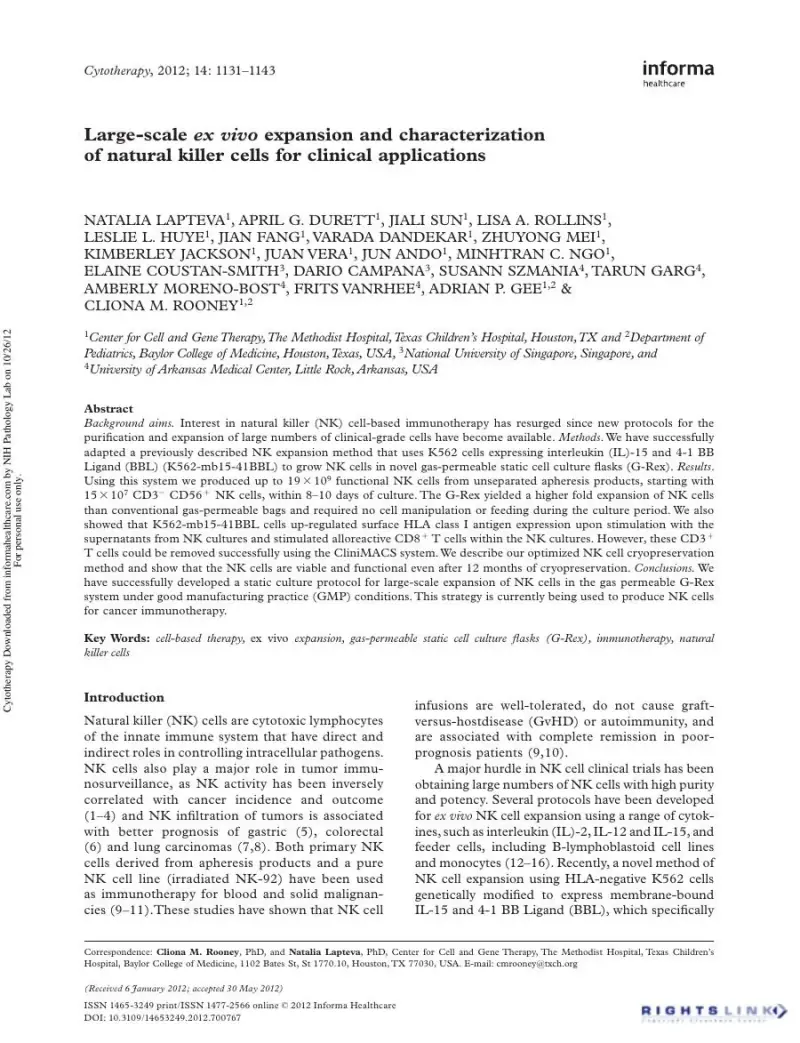
Overview
Describes a static culture protocol for expanding NK cells using K562-mb15-41BBL feeder cells in G-Rex® devices. The G-Rex® system yielded higher fold expansion (>100-fold) and total cell numbers compared to gas-permeable bags, with no feeding required during the 8-10 day culture period
What this paper found
NK cells can be expanded more than 100-fold in static G-Rex® gas-permeable flasks without medium exchange, offering a simpler route to clinical-scale doses than gas-permeable bags. Peripheral blood mononuclear cells were co-cultured for 8 to 10 days with irradiated K562-mb15-41BBL feeder cells and 10 U/mL IL-2. In G-Rex®100 flasks seeded with 4 × 10^6 NK cells, expansion averaged 175-fold, and in a side-by-side comparison G-Rex® flasks gave higher fold expansion than bags without interim feeding. Clinical-scale runs produced up to 19 × 10^9 NK cells from 15 × 10^7 seeded cells. Contaminating T cells (less than 35%) could be removed by magnetic depletion, and cryopreserved NK cells remained viable and potent after 12 months.
Note: Cryopreservation stability data at 12 months come from only two products, and the authors note that larger stability studies on clinical products are required.
We have successfully developed a static culture protocol for large-scale expansion of NK cells in the gas permeable G-Rex system under good manufacturing practice (GMP) conditions. — Natalia Lapteva, April G. Durett, Jiali Sun, Lisa A. Rollins, Leslie L. Huye, Jian Fang, Varada Dandekar, Zhuyong Mei, Kimberley Jackson, Juan Vera, Jun Ando, Minhtran C. Ngo, Elaine Coustan-Smith, Dario Campana, Susann Szmania, Tarun Garg, Amberly Moreno-Bost, Frits Vanrhee, Adrian P. Gee, Cliona M. Rooney, Cytotherapy
Study details
- Authors
- Natalia Lapteva, April G. Durett, Jiali Sun, Lisa A. Rollins, Leslie L. Huye, Jian Fang, Varada Dandekar, Zhuyong Mei, Kimberley Jackson, Juan Vera, Jun Ando, Minhtran C. Ngo, Elaine Coustan-Smith, Dario Campana, Susann Szmania, Tarun Garg, Amberly Moreno-Bost, Frits Vanrhee, Adrian P. Gee, Cliona M. Rooney
- Institution
- Center for Cell and Gene Therapy, The Methodist Hospital, Texas Children’s Hospital, Houston, TX, USA · Department of Pediatrics, Baylor College of Medicine, Houston, Texas, USA · National University of Singapore, Singapore · University of Arkansas Medical Center, Little Rock, Arkansas, USA
- Journal
- Cytotherapy
- Year
- 2012
- G-Rex® model(s)
- G-Rex®10, G-Rex®100
- Cell type(s)
- NK Cells
- Application area
- Hematologic malignancy
- Study phase
- Preclinical
How G-Rex® was used
PBMC were seeded into G-Rex®100 flasks (100 cm² gas-permeable surface, 400 mL medium) at 2–8 × 10^4 NK cells/cm², with irradiated K562-mb15-41BBL feeder cells at a 1:10 NK to feeder ratio in SCGM with 10% FBS and 10 U/mL IL-2. A G-Rex®10 with 40 mL was also used. Cultures ran 8–10 days with no feeding at the selected 4 × 10^6 seeding density, and the only manipulation was a glucose check on days 4, 6, 8 and 10. At 4 × 10^6 NK cells per G-Rex®100, expansion averaged 175-fold. Clinical runs seeded 9 × 10^7 to 15 × 10^7 NK cells in G-Rex®100s and yielded up to 19.2 × 10^9 NK cells.
Explore related

Full citation
Lapteva N, Durett AG, Sun J, et al. Large-scale ex vivo expansion and characterization of natural killer cells for clinical applications. Cytotherapy. 2012;14(9):1131-1143.
Building a similar workflow?
Talk to a ScaleReady specialist about how the G-Rex® platform can support your program — from process development to clinical-scale manufacturing.


