
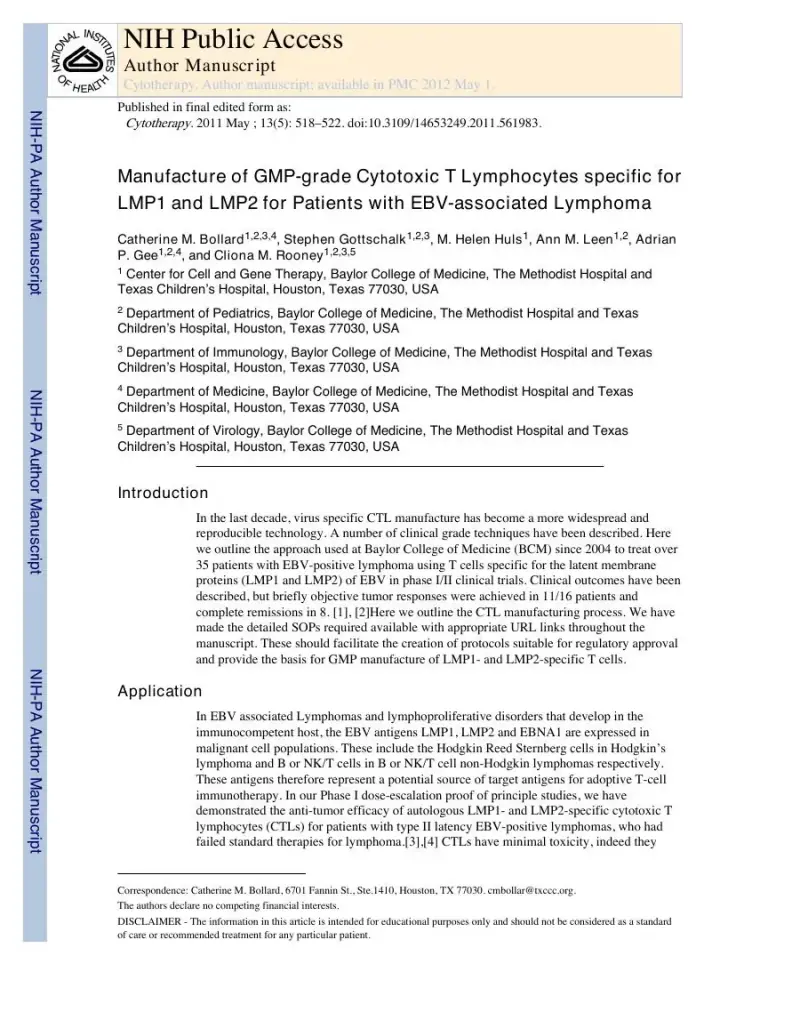
Manufacture of GMP-grade Cytotoxic T Lymphocytes specific for LMP1 and LMP2 for Patients with EBV-associated Lymphoma
Overview
Outlines GMP manufacturing of LMP1/LMP2-specific CTLs for EBV-associated lymphoma. Describes using G-Rex® devices for the second stimulation and expansion phases to support high-density cell growth. G-Rex® simplifies the process and reduces labor compared to traditional 24-well plates while maintaining cell quality
What this paper found
Baylor College of Medicine's GMP process makes cytotoxic T lymphocytes (CTLs) specific for the EBV latent membrane proteins LMP1 and LMP2 to treat relapsed EBV-positive lymphoma with type II latency, an approach used since 2004 in over 35 patients in phase I/II trials, with objective responses in 11 of 16 patients and 8 complete remissions. CTL lines are initiated from patient or donor PBMCs with antigen-presenting cells expressing LMP1 and LMP2 from a replication-incompetent adenovirus vector in the presence of IL-15, then expanded with transduced LCLs and IL-2. Later LCL stimulations can be done in 24-well plates or in the G-Rex® gas-permeable device at responder-to-stimulator ratios of 4:1 and 1:5. Release criteria include viability above 70%, endotoxin at or below 5 EU/ml and under 10% killing of patient PHA blasts.
Note: Monocytes work as APCs for reactivating LMP-specific T cells from healthy donors but not from lymphoma patients, whose T cells are described as anergized, low frequency or fragile; patient-derived lines therefore use adenovirus-transduced dendritic cells for the first stimulation.
since modifying our manufacturing protocol to add IL-15 at the time of CTL initiation we have routinely been able to generate CTL that are specific for these LMP antigens irrespective of HLA type. — Catherine M. Bollard, Stephen Gottschalk, M. Helen Huls, Ann M. Leen, Adrian P. Gee, Cliona M. Rooney, Cytotherapy
Study details
- Authors
- Catherine M. Bollard, Stephen Gottschalk, M. Helen Huls, Ann M. Leen, Adrian P. Gee, Cliona M. Rooney
- Institution
- Center for Cell and Gene Therapy, Baylor College of Medicine, The Methodist Hospital and Texas Children's Hospital, Houston, Texas, USA · Department of Pediatrics, Baylor College of Medicine, The Methodist Hospital and Texas Children's Hospital, Houston, Texas, USA · Department of Immunology, Baylor College of Medicine, The Methodist Hospital and Texas Children's Hospital, Houston, Texas, USA · Department of Medicine, Baylor College of Medicine, The Methodist Hospital and Texas Children's Hospital, Houston, Texas, USA · Department of Virology, Baylor College of Medicine, The Methodist Hospital and Texas Children's Hospital, Houston, Texas, USA
- Journal
- Cytotherapy
- Year
- 2011
- Cell type(s)
- CTL Cells, VST Cells
- Application area
- Hematologic malignancy
How G-Rex® was used
For the second and later stimulations, LMP-specific T cells can be cultured either in 24-well plates or in the G-Rex® gas-permeable cell expansion device, following SOP D03.16. In the G-Rex®, irradiated LCLs transduced with the Ad5f35-LMP1/2 vector are added at a responder-to-stimulator ratio of 1:5, compared with 4:1 in 24-well plates.
Note: The first stimulation, with dendritic cells or monocytes as antigen-presenting cells, is done in 24-well plates; the G-Rex® is used from the second stimulation onward.
Explore related
Full citation
Bollard CM, Gottschalk S, Huls MH, Leen AM, Gee AP, Rooney CM. Manufacture of GMP-grade Cytotoxic T Lymphocytes specific for LMP1 and LMP2 for Patients with EBV-associated Lymphoma. Cytotherapy. 2011;13(5):518-522.
Building a similar workflow?
Talk to a ScaleReady specialist about how the G-Rex® platform can support your program — from process development to clinical-scale manufacturing.


