Share
G-Rex’s (gas permeable, rapid expansion) core technology can be understood in three simple concepts:

1cm² Gas Permeable Membrane
The combination of these basic elements confer the following benefits:
Moreover, the simplicity of the G-Rex confers the following advantages:
A revolutionary technology used by over 1,000 organizations doing CGT research & discovery, preclinical and clinical development, and commercial production of five (5) approved drug products (including the world’s most financially successful and most commercially scalable CGT drug product). Visit our Knowledge Center to browse hundreds of peer-reviewed manuscripts related to all forms of CGT modalities including CAR/TCR-T cells, Natural Killer (NK) cells, Tumor Infiltrating Lymphocytes (TIL), regulatory T cells (Treg), gamma delta T cells, virus- and tumor antigen-specific T cells, hematopoietic stem cells (HSC), and more!
The G-Rex membrane is made from a USP Class IV silicone elastomer which has been shown to be several orders of magnitude more permeable to O2 & CO2 than the material from which gas-permeable bags are made (FEP).
The G-Rex membrane is not plasma-charged or texturized and naturally supports suspension culture. It has been previously demonstrated that coating materials such as RetroNectin can be applied to the membrane to enhance unit operations such as T cell activation (via immobilization of activating antibodies) and T cell transduction.
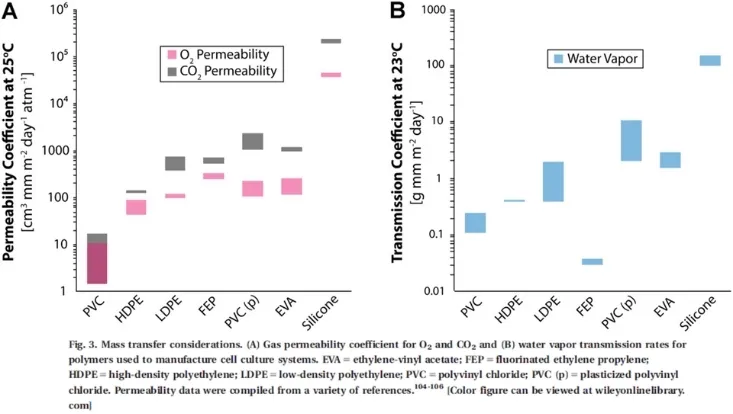
Fekete, N., Béland, A. V., Campbell, K., Clark, S. L., & Hoesli, C. A. (2018). Bags versus flasks: A comparison of cell culture systems for the production of dendritic cell–based immunotherapies. Transfusion, 58(7), 1800–1813. https://doi.org/10.1111/trf.14621
In physics and fluid mechanics, a boundary layer is the thin layer of fluid in the immediate vicinity of a bounding surface formed by the fluid flowing along the surface. The fluid’s interaction with the wall induces a no-slip boundary condition (zero velocity at the wall). The flow velocity then monotonicaly increases above the surface until it returns to the bulk flow velocity. The thin layer consisting of fluid whose velocity has not yet returned to the bulk flow velocity is called the velocity boundary layer.
Scanning electron microscopy images have demonstrated that the G-Rex’s boundary layer is approximately 300 microns in height above the silicone and this is the area where the cells grow within. Thus, the size of the cell being grown will determine how many cells can be grown on a per cm^2 basis.
| CELL TYPE | DIAMETER | MAX DENSITY |
|---|---|---|
| T cells | DIAMETER 8-9um | MAX DENSITY 30-40M cells/cm² |
| NK cells | DIAMETER 8-9um | MAX DENSITY 30-40M cells/cm² |
| k562 | DIAMETER 17-22um | MAX DENSITY 12-15M cells/cm² |
| Hybridoma | DIAMETER 11-13um | MAX DENSITY 15-16M cells/cm² |
Yes, it has been demonstrated that polyclonality is maintained and that cells expanding with the oxygen & nutrient rich boundary layer maintain clonal diversity.
This is of particular importance to developers of Tumor Infiltrating Lymphocyte (TIL) therapies where clonal diversity is an asset.
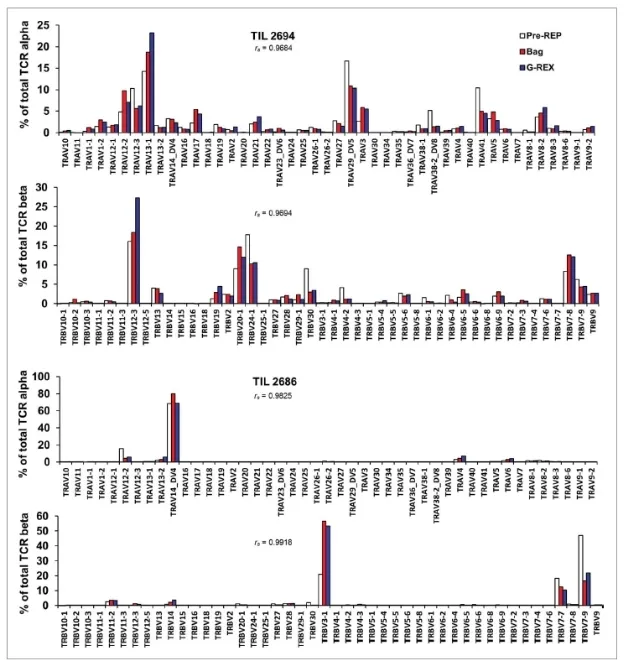
Forget, M.-A., Haymaker, C., Dennison, J. B., Toth, C., Maiti, S., Fulbright, O. J., Cooper, L. J., Hwu, P., Radvanyi, L. G., & Bernatchez, C. (2015). The beneficial effects of a gas-permeable flask for expansion of tumor-infiltrating lymphocytes as reflected in their mitochondrial function and respiration capacity. OncoImmunology, 5(2). https://doi.org/10.1080/2162402x.2015.1057386
A core benefit of static culture is that there is extensive cell-to-cell contact and any secreted factors essential to cell expansion will exist as gradients, with the highest concentration surrounding the cells.
Contrast this with perfusion systems, such as WAVE, where any secreted factors will be diluted by the continual perfusion while the constant motion will reduce the overall time the cells spend in contact with each other.
Somerville, R. P., Devillier, L., Parkhurst, M. R., Rosenberg, S. A., & Dudley, M. E. (2012). Clinical scale rapid expansion of lymphocytes for adoptive cell transfer therapy in the WAVE® bioreactor. Journal of Translational Medicine, 10(1). https://doi.org/10.1186/1479-5876-10-69
The highly oxygenated, nutrient rich, and no-sheer boundary layer confers the following benefits:
(1) Forget, M.-A., Haymaker, C., Dennison, J. B., Toth, C., Maiti, S., Fulbright, O. J., Cooper, L. J., Hwu, P., Radvanyi, L. G., & Bernatchez, C. (2015). The beneficial effects of a gas-permeable flask for expansion of tumor-infiltrating lymphocytes as reflected in their mitochondrial function and respiration capacity. OncoImmunology, 5(2). https://doi.org/10.1080/2162402x.2015.1057386
(2) Vera JF, Brenner LJ, Gerdemann U, Ngo MC, Sili U, Liu H, Wilson J, Dotti G, Heslop HE, Leen AM, Rooney CM. Accelerated production of antigen-specific T cells for preclinical and clinical applications using gas-permeable rapid expansion cultureware (G-Rex). J Immunother. 2010 Apr;33(3):305-15. doi: 10.1097/CJI.0b013e3181c0c3cb. PMID: 20445351; PMCID: PMC2946348.
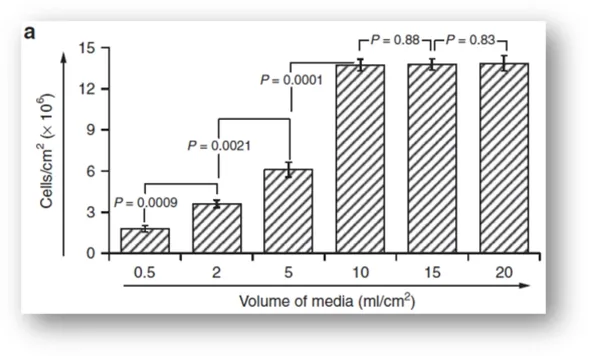
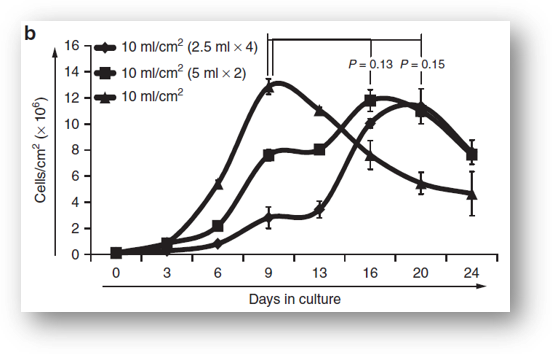
The “golden ratio” of 10mL/cm2 was determined through media titration studies (Right) to be the least amount of media required to sustain a culture from a seeding density to maximum cell density without the need to exchange the culture media.
No, there are several reasons why G-Rex production does not require intermittent supplementation of cytokines:
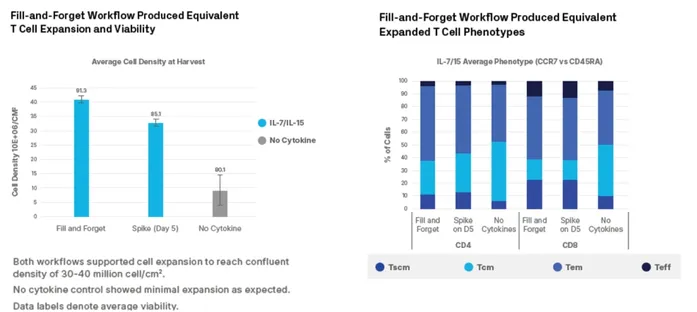
Frontloading a bolus of media at the onset of expansion, and maximizing the size of the cells’ nutrient pool and waste sink, has been demonstrated to yield better expansion kinetics.
Forget, M.-A., Haymaker, C., Dennison, J. B., Toth, C., Maiti, S., Fulbright, O. J., Cooper, L. J., Hwu, P., Radvanyi, L. G., & Bernatchez, C. (2015). The beneficial effects of a gas-permeable flask for expansion of tumor-infiltrating lymphocytes as reflected in their mitochondrial function and respiration capacity. OncoImmunology, 5(2). https://doi.org/10.1080/2162402x.2015.1057386
Let’s talk more about how ScaleReady can advance your cell and gene therapy research and manufacturing with ingenious efficiency.
ScaleReady is a joint venture between Wilson Wolf Manufacturing and Bio-Techne.